Atomic Habits: Forcing Functions to Form Good Habits and Fulfill New Year's Resolutions

Paul Asel
Founding Partner at NGP Capital·
We are the sum of our habits. Here are eight action items to build Atomic Habits and reach your full potential.
Idea in Brief
- We do not rise to the level of our goals. We fall to the level of our habits.
- Atomic Habits are basic daily activities that compound over time augmenting capacity for growth.
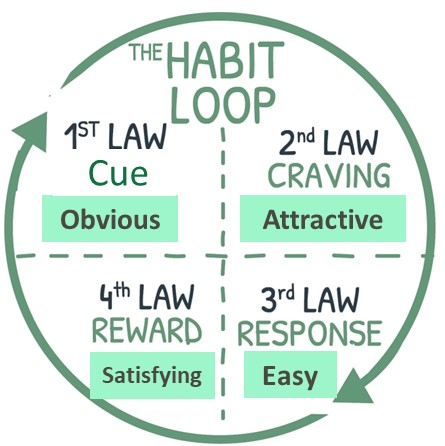
- The Habit Loop: Cue, Craving, Response, Reward – make it obvious, attractive, easy, satisfying.
- Forming Atomic Habits: (1) align habits with core goals; (2) start simple & easy; (3) insert new behaviors into existing routines; (4) track progress daily; (5) recruit peer group to reinforce habits.
‘The chains of habit are too weak to be felt until they are too strong to be broken.’ Samuel Johnson
“Champions don’t do extraordinary things. They do ordinary things, but they do them without thinking, too fast for the other team to react. They follow the habits they’ve learned.” Tony Dungy, Indianapolis Colts football coach, which won Super Bowl XLI
The holiday season is a time of reflection. Past successes reinforce prior behavior. We learn more from disappointments than successes, and they often are fodder for New Year’s Resolutions in the year ahead.
But New Year’s Resolutions have a checkered history. They have a half-life of thirteen weeks as apps that promote health clubs, yoga classes and better diets see a surge in subscriptions in January followed by waning interest in February and March. Without better systems to alter behaviors, we are bound to repeat mistakes from the past. How do we improve performance on our newborn Yuletide resolve?
We are the sum of our habits. Personal development books laud Grit and Drive, yet the spirit is willing but the flesh weak on matters left solely to resolve. Willpower is David to the Goliath of entrenched habits. Changing habits requires more than the fiat of New Year’s Resolutions. As Duhigg notes in The Power of Habits, we must reconfigure cues, incentives and rewards to alter engrained behaviors. Atomic Habits observes that we do not rise to the level of our goals but fall to the level of your systems. Small, incremental (“atomic”) habits compound over time to produce remarkable change. Clear’s Four Laws of Behavior Change – make it obvious, attractive, easy and satisfying – creates a positive feedback loop to reinforce good habits and expunge bad ones.
Figure 1: The Habit Loop: Four Laws of Behavior Change
New Year’s Resolutions falter because they seek better outcomes without altering the root cause of our underlying behaviors. We need to dig deeper and reconfigure the systems that govern habit formation. Persistent cues trigger old habits, so our willpower can withstand these triggers only briefly and old habits reemerge. To make New Year’s Resolutions stick, we must either change our environment to eliminate cues or create a new set of cues. When cues remain in place as they often do, then we can insert new behaviors behind those cues and create rewards that reinforce our desired behaviors.
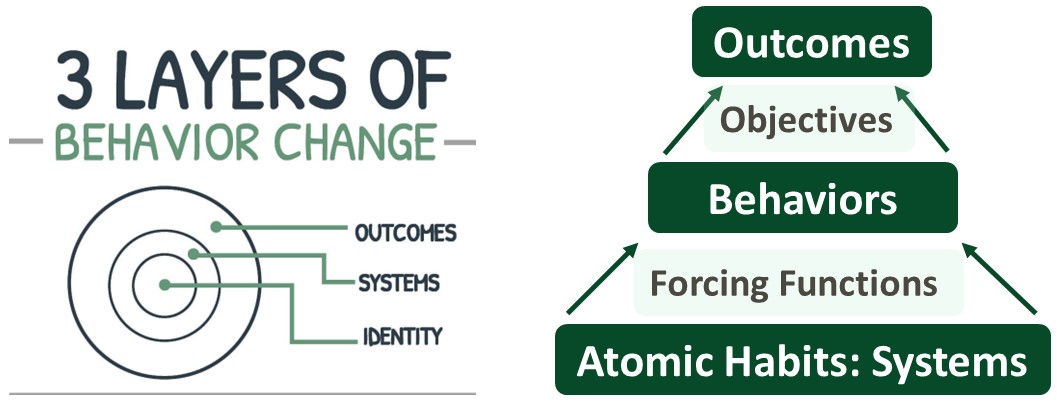
Atomic habits is a compelling concept that identifies two levels of habits. Atomic habits are the foundation on which higher level habits are built. They are the source code that trigger basic behaviors and, when constructed well, help build new routines and form better higher-level habits.
Figure 2: Atomic Habits – Foundations and Forcing Functions Altering Engrained Behaviors
Atomic Habits is the most widely self-management book written in the past quarter century. Atomic Habits introduces a powerful concept as they surface routines that are often invisible to ourselves and others, yet they premeditate behaviors and habits that come to define us.
Atomic Habits are timely as they are highly relevant to our New Year’s Resolutions. Our resolutions yield long-term results only if we address the underlying systems that alter the behaviors we seek to change. Atomic habits offer both a challenge and reward. We must dig deeper to fulfill our New Year’s Resolutions, but we can unlock much more hidden potential when we do so. Developing good atomic habits have a compounding effect as they enable us to build new routines and reach outsized objectives over the course of months, years and decades that would not have been otherwise attainable.
Atomic Habits: Selected Forcing Functions to Form Good Habits
Here are eight atomic habits I have come to rely on over the years. A sense of purpose defines personal identity while the next seven reinforce routines that support our broader objectives. Your set of atomic habits may differ, but I hope you will find some of these useful in building your atomic habits and achieving your full potential.
-
Purpose: For my father, a minister, a purpose driven life was the highest calling: “If you have a sense of purpose, don’t stoop to be a king.” Decades later, Rick Warren’s The Purpose Driven Life shared this view with a broader audience. Early in my career, a roommate asked himself aloud each evening, “What have I done today to justify my existence?” That question and my father’s dictum have remained top of mind for the last four decades. A purpose driven life led me to volunteer to assist in the recovery of Eastern Europe after the Berlin Wall fell, work in emerging markets helping alleviate poverty with the World Bank and found four financial firms that funded mission-driven startups that seek to ‘make a dent in the universe’. A strong sense of purpose burns that coheres our varied work throughout life.
-
Disciplines: As Tony Dungy noted above, extraordinary results emerge from ordinary habits. Good habits are automatic, thinking fast responses that preserve mental energy for vital, thinking slow decisions. It is easier to foreswear sweets and alcohol altogether, for example, than moderate impulses every time one encounters these temptations. Good habits compound over time unleashing virtuous cycles that emanate from consistent performance. Much as good companies establish policies to align employee activity, develop personal policies to govern your daily activity.
-
4000 Weeks: Life is short. In my youth, a mentor advised, “Don’t spend two years getting a one-year experience.” A sense of urgency resonates even more as our expected 4000-week lifespan dwindles to 1000 weeks. John Wooden, Hall of Fame basketball coach and winner of ten NCAA championships, advised players to be quick but not in a hurry. Wooden divided each season into 200 hours of practice and each practice into five-minute increments. Dividing our lives into smaller increments reinforces a sense of urgency and helps make objectives actionable while allowing time to pivot or course correct as needed. See more on the 1000 Week Paradigm.
-
The Strenuous Life - BHAGs: For our 60th birthdays, a couple friends and I signed up for the 2024 Death Ride, a century bike ride that climbs over six passes ascending 14,000 feet. This initial commitment focused training for the next six months riding over 4000 miles and traveling to Colorado to train at altitude. Big Hairy Audacious Goals (BHAGs) with a specific due date rivet attention and raise the bar. Theodore Roosevelt lauded The Strenuous Life for those who “know the great enthusiasms, the great devotions; who spends himself in a worthy cause …”. Bill Bradley, former Senator and Hall of Fame basketball player, vowed that “Life lived intensely develops a momentum of its own.” BHAGs may require great effort, yet The Strenuous Life offers a roadmap to achieve more than otherwise seems possible.
-
Daily Metrics: New Year’s Resolutions, like any goal, must be SMART to be sticky: Specific, Measurable, Achievable, Realistic and Timely. For the past three decades, I have kept daily metrics to monitor progress toward annual goals. These daily metrics are my personal coach pushing me to do more and serving as an early warning signal when gaps emerge between goals and performance. Each new year, I use my daily log to assess prior performance and plan for the upcoming year. Most annual goals remain consistent so I can measure trends across decades. New Year’s Resolutions – typically one or two but never more than three – become points of emphasis for the year and are added to the log measuring progress either daily or weekly. These are ‘dailyish’ or ‘weeklyish’ objectives with buffer built in for downtime with travel, vacations, and special events. Dailyish objectives allow enough flexibility so measuring daily progress encourages higher performance without becoming a noose.
-
Journals: I received my first diary as a high school graduation present and have kept a digital journal ever since. Over the past four decades, my journal entries have varied in form and frequency to serve my purpose. While daily logs serve as a personal coach, journals are a personal advisor (but not a substitute for wise mentors) helping me develop strategies and think through important decisions. Journal entries sometimes extend for several pages, but usually, I maintain a low bar to encourage shorter, more frequent entries. Journals are personal and customizable to fit your style, preferences and purpose. My standard practice of weekly entries are mostly biographical but also help reinforce my annual goals and 1000 week plan.
-
Reserved Time on Calendar: A to-do list is clutter, a not-to-do-list is discipline. To avoid cluttered calendars, I Timebox my daily calendar to reserve time for important, priority activities. Typically, I Timebox activities early in the day when scheduling conflicts are unlikely and I am most alert. My assistant knows that these Timeboxes are inviolable and may not be overwritten without specific authorization. In Make Your Bed, Admiral McRaven advocates starting each day with one small task accomplished. Starting the day well with a completed priority task reinforces a positive mindset to manage the many urgent yet mundane matters that emerge as the day progresses.
-
Peer Group: The books one reads and company one keeps tell much about a person. Choose friends and mentors wisely as their impact over time can be profound. A supportive, accomplished peer group benefits all participants, even those who engage at a distance. Friends and mentors have helped me be a better person, and I hope I can give back a small portion of the gift I have received from others who have served as role models over the years.
Related Concepts
Atomic Habits employs First Principles Thinking to get to the Root Cause of our behaviors. A Root Cause of our inability to alter engrained behaviors lies in psychological biases such as Base Rate Neglect, Blind Spots and Wishful Thinking. We can overcome these biases, however, using Second Order Thinking.
Atomic Habits leverage Forcing Functions as change agents for engrained behaviors. Timeboxing is an effective way to ensure that time is allotted for priority activities. Forcing Functions may also leverage Escalating Commitment by starting with a small initial commitment that expands into large commitments over time with Positive Reinforcement and evolves into new routines that cement behavioral change. Initial commitments are more likely to escalate into larger commitments when they are aligned with personal or organizational goals and produce early wins that encourage repeat behavior that ultimately solidifies into Deliberate Practice.
The impact of Atomic Habits compound over time and may unleash a Flywheel Effect enabling individuals to reach Escape Velocity and achieve Big, Hairy, Audacious Goals (BHAGs).