
Exit Strategy: Reverse Engineering Successful Outcomes from the Outset

Paul Asel
Founding Partner at NGP Capital·
Successful exits start with the end in mind. Here are six strategies to prepare for a successful exit, including one exercise before you start your business.
Idea in Brief
- Failing to plan is planning to fail. Savvy founders nurture successful outcomes from the start with the end in mind.
- Good exits take time, IPO preparation takes two years, and successful sale may take longer.
- Companies are bought not sold, yet savvy entrepreneurs can reverse engineer the process.
- Most acquisitions fail. Try before you buy partnerships are no regret options. Partnerships increase value when successful and help dodge bullets by avoiding poor fits.
- Successful exits are correlated with Product Market Fit. Product Market fit is not binary. Systematically improving Product Market Fit enhances outcomes.
The above want ad applies as well to startups as the Antarctic: “hazardous journey, small wages … long months of complete darkness, constant danger, safe return doubtful.” Ernest Shackleton offered little beyond “honor and recognition in case of success.” Yet his 1914 expedition to the South Pole attracted over 5000 applications. In a ship appropriately named Endurance, Shackleton did not reach the South Pole, but his extraordinary leadership enabled his entire crew to survive a harrowing three-year odyssey. Shipwrecked in the ice, they wintered on an icefield, carried lifeboats 75 miles across crevassed glaciers, braved a stormy ocean voyage over 831 miles while dodging icebergs, then traversed treacherous mountains and crevasses before the emaciated crew reached safety on Georgia Island.
Startup journeys are equally hazardous as only 75% survive the first year and a third survive ten years. Yet the siren call of “honor and recognition in case of success” draws many entrepreneurs. Over 33 million small businesses comprise 99.9% of all U.S. firms.
Unlike Shackleton’s Antarctic expedition, startups do not win honor and recognition by simply surviving. They must survive and thrive. Only 30% of small businesses grow beyond their founder, yet the very few who scale account for 85% of U.S. job growth. Venture backed startups comprise less than 0.5% of small businesses yet account for 77% of market value and over 50% of initial public offerings since 1978 according to the NVCA.
Successful Outcomes: Failing to Plan is Planning to Fail
Nigeria, a country of 220 million people, has more entrepreneurs than the United States and is third in the world with 37M small businesses. Lagos, a city of 20 million, bristles with the bustle of business. Decades ago, I led a seminar in Lagos for bankers who hoped to launch a local venture capital industry. When we started discussing exit strategies, a boisterous banker boomed, “failing to plan is planning to fail.” Arousing a hearty laugh and standing ovation, his comment contains more truth than entrepreneurs realize. Savvy founders nurture successful outcomes from the start with the end in mind.
Exit Strategy: Most Startups Fail, Most Unnecessarily
The sad truth is that most startups fail. Over the past fifteen years, only 10% of venture backed startups reach public offerings, which generate about 80% of venture returns. Yet IPOs are funding events, not exits, for entrepreneurs. Public firms report quarterly to new shareholders who can enter and exit at will and depart in mass when expectations are missed. Most IPOs underperform expectations and lose value, including 80% of 2023 IPOs that traded below their initial offering price a year later.
Underwater IPOs are, for entrepreneurs and their firms, like being sent to the penalty box in ice hockey only time off the ice is much longer. Institutional investors who leave a public stock typically do not revisit the company for two years. Missed expectations and underwater IPOs can start a vicious circle that is hard to escape. Many entrepreneurs who have led successful public companies say they would never take another company public. Imagine then CEO vituperations of public companies that have underperformed.
The other 90% of venture backed companies that do not go public are either acquired or quietly disappear. Many acquisitions offer successful outcomes for both investors and entrepreneurs, but the dirty secret is that most do not. Half of acquired companies result in a loss for investors. Worse still for entrepreneurs, about 70-90% of acquisitions fail according to Harvard Business Review.
Success has many fathers, but failure is an orphan. Entrepreneurs deserve “honor and recognition in case of success,” yet too few founders achieve the success they deserve for their long, tireless efforts. Too many experience a “hazardous journey, small wages … long months of complete darkness, constant danger” with little recompense at the end. Most entrepreneurs deserve better, but “failing to plan is planning to fail.”
Exit Strategy: Preparing from the Outset for a Successful Outcome
“All happy families are alike; each unhappy family is unhappy in its own way.” As Leo Tolstoy suggested, there are many ways to fail but most successes share common traits. Following are six ways entrepreneurs can lay the foundation for successful outcomes from the outset.
- Pre-Parades – Planning for Success at the Start: Amazon writes a draft press release at the proposal stage describing the success of the new initiative. Sequoia Capital prepares a pre-parade and pre-mortem describing how a startup succeeded or failed before they invest. These exercises help keep eyes on the prize while wary of potential missteps. Savvy entrepreneurs can plan for success from the outset. A clear vision helps avoid the siren call of tangential distractions and steels founders when surprises arise. Create two checklists for key success factors in your pre-parade and pitfalls to avoid in your pre-mortem and refer to these as you consider founder’s dilemmas and other major business decisions.
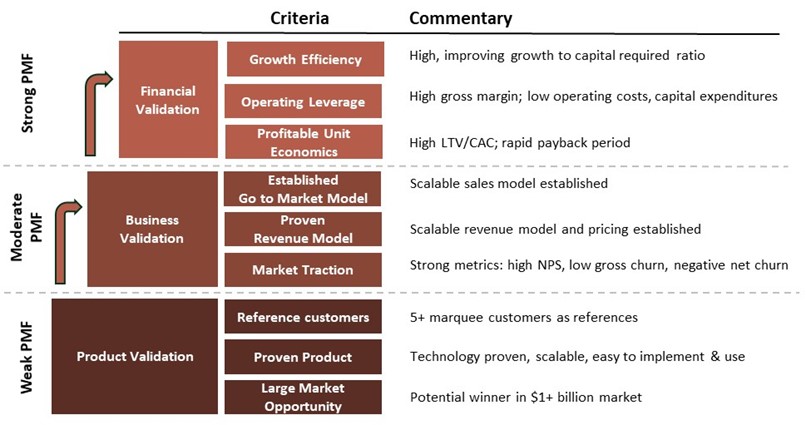
- Climbing the Product Market Fit Ladder: Most think of Product Market Fit in binary terms: you either have it or you don’t. Product Market Fit is an ongoing process. Product Market Fit progresses through three stages validating first the product, then the business model, and finally unit economics (see Figure 1). Across over 100 investments at NGP Capital, we found that firms with product validation had a 25% success rate, business validation a 50% likelihood of success, and financial validation over 90%. Yet if Product Market fit is considered binary, entrepreneurs may take a set it and forget it approach and stall unnecessarily at early or medium Product Market Fit. By systematically climbing the ladder focusing on one layer at a time, startups improve both capital efficiency and success rate.
Figure 1: Three Stage of Product Market Fit
- Public Offerings – Patience is a Virtue: Most companies go public too early and debut when they can instead of when they should. Public firms must consistently hit their numbers delivering predictable revenue growth with solid and improving unit economics. As my review of 123 U.S. IPOs in 2023 indicates, market performance bifurcates between firms prepared for public scrutiny and those that are not. Among firms that raised over $100 million, 63% are now valued above their IPO price and have increased their share price 68% on average. Over 90% of the others have lost value and are trading 56% below their average IPO price. Firms with successful offerings typically work with investment bankers for two years or more to prepare for an IPO ensuring they have the discipline and maturity to deliver reliably on quarterly financial targets when they are public firms.
- Acquisitions – Companies are Bought not Sold: Early in my career, as an investment banker and later as a corporate acquirer, I learned quickly that companies are bought not sold. But savvy entrepreneurs can reverse engineer the process. If IPOs need two years of preparation, successful acquisitions often take longer. Entrepreneurs should assiduously court potential buyers much like customers. Meet potential buyers early and often. Understand complementarities, strategic fit and threshold requirements for acquisition. Adjust your business strategy to ensure your firm is well positioned with preferred acquirers when it is time to sell.
- Increase Success Rate – Try Before You Buy or Sell: Failed acquisitions matter little to investors who have long exited but are painful for entrepreneurs who remain with the business and have a large stake in a successful merger. While 70-90% of acquisitions fail, entrepreneurs can tip the scales toward success by partnering with multiple potential acquirers to test product compatibility and explore potential synergies. Successful partnerships yield higher valuations by reducing acquisition risk and creating demand from several potential buyers. If a partnership falters, consider this a bullet dodged with a prospective buyer.
- Eat When Served – Selling When Prospects are Good: Warren Buffett once quipped that the reason he made so much money is he sold too early. Rarely does it appear a propitious time to sell. When prospects are good, one is tempted to keep going to secure a higher future valuation. But interest evaporates when performance ebbs or times are tough. Successful acquisitions require ongoing performance and synergies to justify premium valuations. Acquisitions often include earnouts where a meaningful portion of the proceeds is pending future performance. Earnouts and stock rather than cash transactions are good ways to align interests, capture future value and bridge valuation gaps between buyers and sellers.
Finishing well is important financially and psychologically as our view of past experiences weighs disproportionately on how they finish. For both investors and entrepreneurs, good outcomes require good exits.
Athletes know that finishing well requires having energy left for a strong kick at the end. But to win the race, one must be well positioned on the final lap, which is the sum of all prior effort. To earn “honor and recognition in case of success,” entrepreneurs must prepare for good outcomes from the outset. Otherwise, failing to plan is planning to fail.
Exit Strategy: Related Concepts
Exit strategy is a top consideration for investors and often secondary for entrepreneurs. Venture firms must realize exits to secure a Return on Investment (ROI) and raise new funds. Entrepreneurs consider Return on Time Invested (ROTI) as well as ROI. They share financial interests with investors but have personal interests based on time and influence on the firm. Investors should consider Alignment of Interests with entrepreneurs and other investors at the outset as minor differences become magnified in Crucible Moments, especially as an exit approaches.
It is useful to do Scenario Analyses at the outset of a startup or investment and revisit them when evaluating exit options. Scenario analyses help entrepreneurs and investors assess the upside risk/reward attributes of a potential exit. When there is optionality in a potential exit decision, scenario analyses are essential inputs in a Regret Minimization Framework and helps Boards reach consensus on an outcome.