Founder Fit: Experience vs. Insight

Paul Asel
Founding Partner at NGP Capital·
Experience is an unreliable guide for Founder Fit. This Founder Opportunity Fit framework focuses on insight instead of experience.
Idea in Brief
- Experience is a reliable guide for incremental but not disruptive innovation.
- Investors focused on experience would miss the iconic tech firms of our generation. Founder Fit based on experience adequately assesses 98% of startups but misses 50% of startup value.
- Founders of disruptive startups are industry outsiders. Outsiders bring fresh thinking unencumbered by industry wisdom and unbridled by ‘best’ practices.
- Founder Opportunity Fit focuses on founder insights and capacity to seize opportunities independent of experience.
What do Bill Gates, Mark Zuckerberg, Elon Musk, Larry Page, Sergey Brin and Michael Dell have in common? These founders of Microsoft, Facebook, Tesla, Google and Dell have created pathbreaking technology firms together worth $4 trillion.
They also founded these companies in college.
Investors prize experience and prior success among entrepreneurs they back. Early-stage investors focus on Founder Market Fit as the primary indicator of startup success. One industry observer highlighted eight signs that an entrepreneur has strong Founder Market Fit. These eight attributes rely on prior experience referring to industry and market know-how six times:
- You have been working in your industry for several years
- You have a large network in your industry
- You have held different roles in your industry and understand the key players
- You have lived and breathed the problem you are solving firsthand and deeply understand the pain points
- You can speak fluently about your industry and the problem you are solving
- You understand the current and future competitive landscape of your industry
- You identify with your customer because you have either been your own customer or have conducted extensive research analyzing your early cohorts
- You have become obsessed with the problem you are solving and have been relentless in learning everything about the market
An investor who adheres solely to these indicators would have missed many of the iconic technology companies of our generation. Half the founding CEOs of disruptive, unicorn startups with successful initial public offerings (IPOs) claimed to have difficulty raising initial funding. The CEOs of Peloton and Pinterest were rejected by over one hundred venture firms and described their experience raising initial funding as ‘bone crushing.’ Jeff Bezos needed a year to raise the initial funding round for Amazon. One wonders how many potentially game changing startups were stillborn due to early-stage venture neglect.
Investors prize founders with deep domain experience who understand their target markets well, but industry experience is irrelevant for markets that do not exist. Investor preference for industry experience overlooks high potential opportunities sponsored by outsiders. Up to 98% of innovation is incremental, so investors are preconditioned to focus on experience for Founder Market Fit. Yet focusing on prior experience misleads when it matters most as disruptors account for half of NASDAQ market value as shown in Figure 1.
Figure 1: Successful Startups Launched by Founders without Prior Industry Experience

Experience: Incremental v. Disruptive Innovation
Successful startups illuminate underappreciated Founder Fit traits. Since unicorns and IPOs are the holy grails of ambitious founders, my study focuses on 162 cofounders from 75 venture-backed technology IPOs from 2019-21 that yielded valuations exceeding $1 billion.
The founding CEOs of these newly minted unicorn IPOs were young averaging less than 32 years old with eight years of work experience at startup inception. But one-third of the founders representing half of the combined $800 billion market value of these IPOs as of October 2022 had no prior industry experience.
This bifurcation of founder experience among successful startups is explained by distinguishing between disruptive and incremental innovation. In Zero to One, Peter Thiel describes this distinction as Zero to One and One to N innovation. Zero to One refers to disruptive technology that creates a new order of things, while One to N indicates incremental innovation that improve on existing technologies and practices.
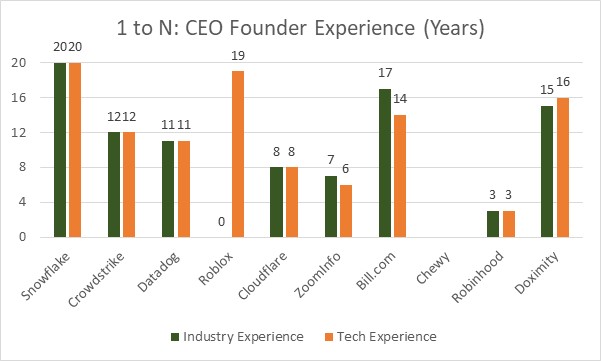
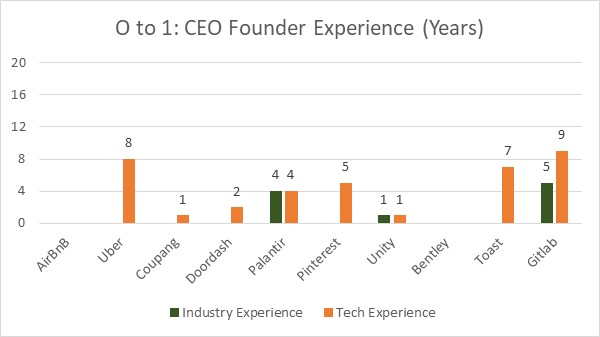
Incremental innovation benefits from industry experience, while disruptive innovation comes from outsiders unencumbered by standard industry practice. Founding CEOs of the 41 One to N unicorn IPO companies started their firms at age 34.8 on average compared with 28.5 years old for the 34 Zero to One companies. One to N founders were over six years older, had over four times more industry experience (8.6 years v. 2 years), and over two times more technology experience (11 years v. 4.3 years) than founders of Zero to One companies. Figure 2 illustrates the difference showing industry and technology experience for the top ten companies by market value in each category.
Figure 2: Prior Founder Industry Experience for 0 to 1 Innovators v. 1 to N Innovators
The Outsider’s Advantage
Disruption often surfaces from outside the industry: 62% of CEO founders in Zero to One startups had no prior industry experience. Disruptors are iconoclasts who see things differently, find opportunity in challenges, are untamed by industry norms and undaunted by subverting industry incumbents.
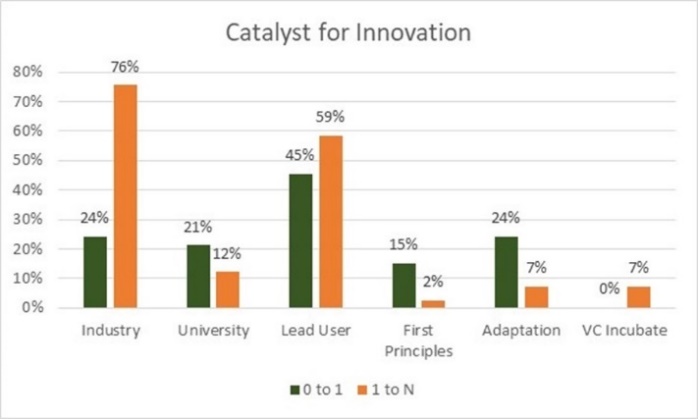
Outsiders identify links to other industries, bridge overlooked gaps in the market and reimagine businesses from a first principles perspective. As shown in Figure 3, 45% of founders of disruptive startups attribute their inspiration to insight as frustrated users or customers. The catalyst for innovation in other disruptive startups emerge equally from four other sources: industry experience, university coursework, first principles thinking and adaption from other industries.
Figure 3: Catalysts for Innovation in 0 to 1 and 1 to N Startups
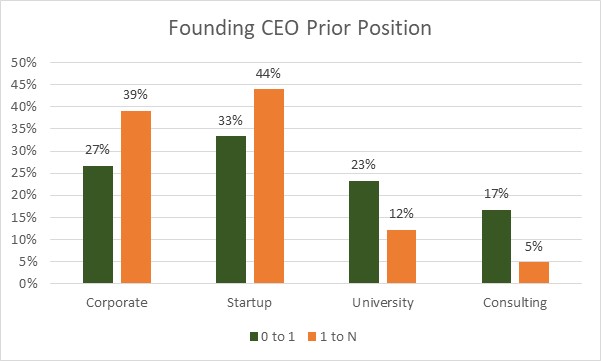
Adaptability is vital to founder success as startups operate in fast changing, uncertain environments. This is especially true for disruptive innovation. Almost half of Zero to One startups pivoted prior to reaching product market fit, more than twice the rate of One to N startups.
Half of founding CEOs in their twenties pivoted with startups, again more than twice the rate of their peers over thirty. While inexperience may account for some needed adjustments, youthful flexibility is an adaptive trait when navigating startups through uncharted waters.
Enterprise selling favors founders with established industry networks, accepted best practices and traditional go to market strategies. CEOs of startups selling to large enterprises had more industry experience, while younger founders target small and medium sized companies where incumbency advantages are lower. Other benefits of industry experience include networks from which to tap top talent, credibility to attract early adopters, and know-how to strategically position the business.
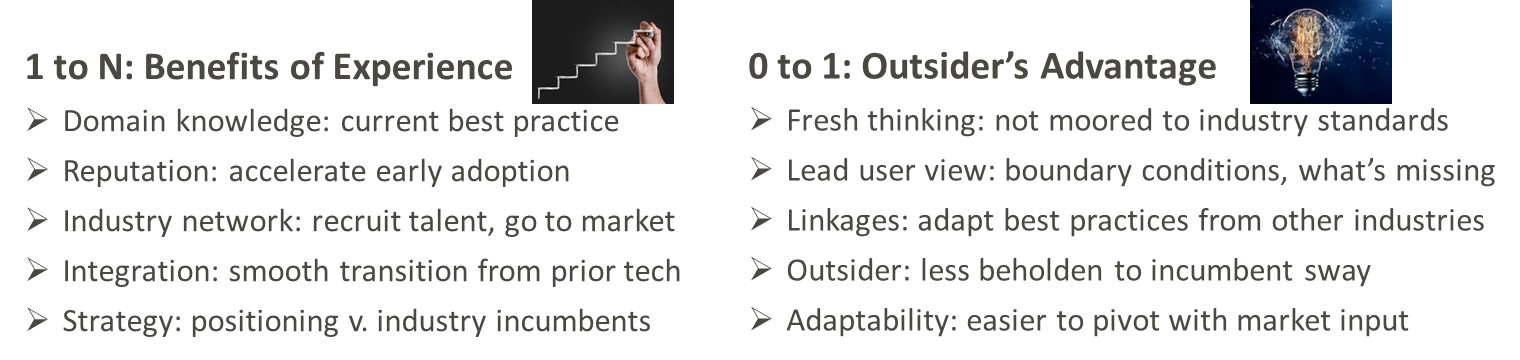
Figure 4 summarizes the benefits of experience for incremental innovation and an outsider’s perspective for disruptive innovation.
Figure 4: Benefits and Blind Spots of Industry Experience with Incremental and Disruptive Innovation
Founder Opportunity Fit v. Founder Market Fit
How does one evaluate Founder Fit in the absence of experience?
Founder insight, not experience, is the shared trait among founders of successful disruptive startups. Interviews with founders consistently revealed insights that drove them to launch their startups. Industry experience was a reliable source of insights for incremental innovation. Disruptive insights typically came from inspiration outside the industry: from lead user insight, concepts applied from other industries, or first principles thinking to identify overlooked opportunities or see known problems from a different perspective.
Founder Market Fit emphasizes industry experience, which is relevant for incremental but not disruptive innovation. Over 80% of founding CEOs of One to N companies had prior industry experience and sourced their startup idea from this experience. Over three-quarters of experienced founders readily received funding.
But at least half the founding CEOs with little or no prior industry experience had difficulty raising early funding. Unmoored by inexperienced founders and formative, unproven ideas, early investors lacked their traditional guideposts and typically discarded Zero to One startups.
Investors need a different paradigm for evaluating disruptive startups. Founder Opportunity Fit focuses on the nature of the opportunity, founder insights that produce first mover advantage, and their capacity to seize the opportunity.
Founder Opportunity Fit recognizes and accepts startups that pursue opportunities without established markets. Founder Opportunity Fit focuses on insights born from an Outsider’s Advantage rather than the experience.
Having established the unreliability of industry experience for startup success, we turn next to framework to assess Founder Opportunity Fit, which I describe in my next blog.
Founder Fit: Related Concepts
Founder Fit precedes Product Market Fit and is one of the first Founder Dilemmas. Bain’s Win/Scale model divides the startup process into two stages but ignores the earlier product development (Get to Market) stage.
Fortune favors the prepared mind, which may guide when to launch your startup. A Team of Teams approach identifies cofounders who fill skill gaps and align with the mission and culture. A Who Scorecard can help assess skill gaps and cofounder fit.
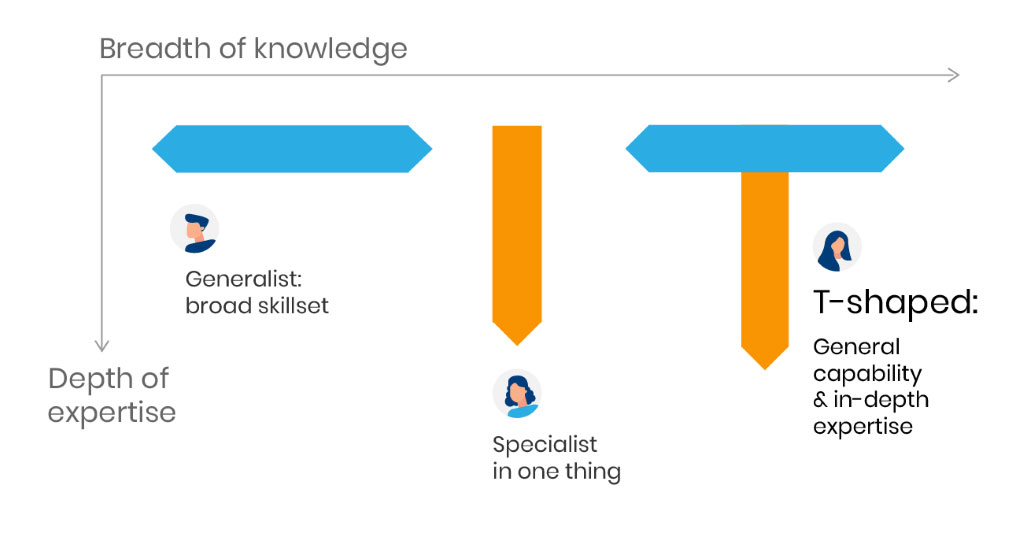
T Shaped Leaders combine breadth and depth. In Good to Great, Jim Collins referred to the Hedgehog and the Fox – the hedgehog knows one thing well, the fox many things. Entrepreneurs need to be adaptable, agile and do many things. But investors look for hedgehogs as entrepreneurs are disproportionally rewarded for insight and being the best at one important thing.
Great promoters are Exothermic and develop Social Capital to attract stakeholders – talent, customers, partners and funding – to accelerate the Flywheel and win markets. Alignment of Interests among stakeholders are essential in Crucible Moments to coalesce and focus externally on the problem.