Founder's Dilemmas: Strategies to Anticipate and Avoid the Pitfalls that can Sink a Startup
Paul Asel
Founding Partner at NGP Capital·
Resilient founding teams align on three Rs: Relationships, Roles & Rewards. Misalignments are hidden, ticking bombs that explode in crucible moments. Here are six strategies to avoid cofounder pitfalls that can sink a startup.
Idea in Brief
- Most startups fail from self-inflicted wounds. Invest up front to align on Relationships, Roles and Rewards.
- Do you seek control or wealth? Control focuses on roles, wealth and investors on rewards.
- Founding teams of 2-3 have higher venture success rates than solo founders or larger teams.
- Relationships: prior work experience is the best indicator of success. Friends & family is less stable and scalable than strangers as partners. Trial periods are a surrogate for prior work experience.
- Structuring founding roles and rewards for growth frees startups to reach their full potential.
We have much to be thankful for as NGP Capital celebrates its twentieth anniversary. Fewer than ten venture firms have consistently invested globally across North America, Europe and Asia as NGP Capital has over the past two decades. We appreciate the dozens of ambitious entrepreneurs who have shared their success with us and investors who have consistently supported us.
Above all, I appreciate the partnership that brought NGP Capital to this landmark milestone. Our early partners – John Garder, Bo Ilsoe, Upal Basu, David Tang, and I – grew the firm together while operating across three continents and fifteen time zones. Peers observing us from afar marveled at the compatibility of our diverse partnership that came from four countries and three professions.
Narratives are neatly knit retrospectively: you can connect the dots looking backward but not forward. The idea of a global venture fund was audacious and perhaps foolhardy when John Gardner and I launched the fund. As we walked the shores of an isolated beach along the California coast, the scenery offered two versions of our contemplated endeavor: the mammoth waves crashed forbiddingly offshore while the late afternoon sun sparkled through the waves’ misty afterglow. Agreeing on a long-term vision for the fund, we took deep breaths and plunged in. Leaving established, well-regarded funds to launch a global venture fund was as bracing as the northern California ocean water. The odds of success were as formidable as the massive waves pounding offshore since China and India were technology newcomers and Europe had long underperformed the U.S. venture market.
John and I had traded sharp elbows on a basketball court for years but had never worked together before we committed to our partnership. Sharp elbows occasionally resurfaced as we navigated through a global financial crisis, a trade war, COVID and changing technology landscape. But our shared vision and aligned interests helped us survive these tempests.
Ultimately, I took the plunge with John on the beach long ago based on one comment from a mutual friend: “I would trust my son with John.” Our mutual friend was spot on. That shared trust and long experience guarding each other on the basketball court enabled us to execute plenty of no-look passes while we operated a continent and often a world away.
Founder’s Dilemmas: Relationships, Roles and Rewards
“If entrepreneurship is a battle, most casualties stem from friendly fire or self-inflicted wounds” as Noam Wasserman observed in Founder’s Dilemmas. Up to 65% of venture-backed startup failures, he notes, result from problems within management teams.
Iconic startups emerge when talented teams and lucrative markets converge. Talent and opportunity are prerequisites for startup success yet, if forced to choose, we back the team. Great teams can pivot when fledgling markets sour, but troubled teams fumble lucrative opportunities every time.
Thiel’s Law observes that "a startup messed up at its foundation cannot be fixed." Peter Thiel, founder of PayPal and Founder’s Fund, has seen many founding teams flourish or flounder. Likewise, no NGP portfolio company has flourished after founder departures due to internal rifts.
Common Pitfalls of Founding Teams
All founding teams start with good intentions, yet too often startups dissolve due to self-inflicted wounds.
Pressure creates diamonds or dust. Startups are pressure cookers, a marathon comprised of a series of 100-yard dashes. Decisions in any single dash can throw startups off course or disqualify them entirely.
Resilient founding teams align on three Rs: Relationships, Roles and Rewards. Misalignment on any of these are hidden ticking bombs that explode at the most inopportune moments.
Relationships: Founding teams typically assemble based on affinity and trust. These are good but insufficient criteria. Wasserman found that cofounders with prior shared work experience have the highest likelihood of success, but teams formed from friendships are less stable than strangers. Homogenous teams breed more conflict due to overlapping skills. Friends and family are better seed investors than cofounders. Family cofounders make it harder to attract and integrate top talent needed to scale the business. Family and friendships also delay and complicate hard decisions when change is needed.
Diverse, balanced cofounding teams are best. Startups with dominant CEOs have 19% lower performance, and consensus-based teams move too slowly. Finding the right balance requires vigilance, care and communication.
Roles: Division of labor is a major source of tension unless skillsets are diverse and roles are clear. For founders focus on control, roles are the source of greatest tension. The desire of multiple founders to be CEO is cancerous but rarely visible externally. Control tendencies tend to backfire as venture investors expect unalloyed focus on wealth creation. Only 62% of founding CEOs retain their CEO role after Series B, 48% after Series C and just 39% after Series D according to Wasserman. Replacing founding CEOs is nonetheless done reluctantly as hired guns are tourists and tend to move on when startups falter, often when their experience is most needed.
High growth startups require flexibility to attract talent and scale the business. Responsibility expands but roles narrow as companies expand. A sense of entitlement hinders growth. Overtitling early in the startup risks having to demote or replace founders.
Rewards: When founders focus on wealth, then rewards are the source of greatest tension. Self-interest is normal but greed is lethal. Equity allocations and compensation are designed to align interests, yet compensation codifies pecking orders, which may alter team dynamics and undermine flexibility as startups grow.
Entrepreneurs are preternatural optimists: 95% think their venture-backed startup has more than a 50% likelihood of succeeding and fully 30% think there is no risk of failure. Overoptimism is a source of friction when startups falter. Many top executives vital to our initial investment decision leave for greener pastures when growth languishes below lofty expectations.
- - -
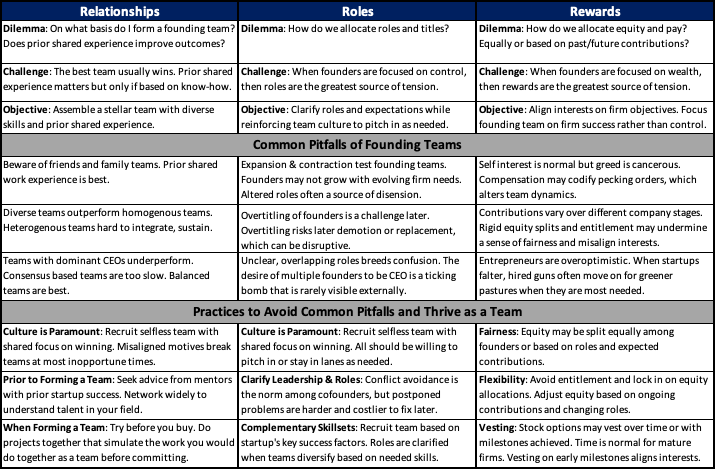
“All happy families are alike; each unhappy family is unhappy in its own way” as Leo Tolstoy remarked in Anna Karenina. Figure 1 summarizes common challenges that cofounding teams face. Our next task is happier as we consider practical strategies to survive and thrive as a startup team.
Figure 1: Founder’s Dilemmas on Relationships, Roles and Rewards
Practices to Thrive as a Startup Team
If founding teams are so hard, why not go it alone? Solo entrepreneurs avoid challenges on shared roles and rewards, yet teams of two or three cofounders outperform single founders and larger team in complex, fast moving situations. In my review, 70% of successful technology IPOs from 2019-21 had multiple founders with an overall average of 2.1 cofounders.
I first learned about Wasserman’s Founder’s Dilemmas from a fellow climber on our trek to Everest base camp. The climber, also a Silicon Valley entrepreneur, observed that cofounding a startup is akin to sharing the ‘bond of the rope’ on mountain climbing expeditions. When alpine climbers are tied into the same rope, their lives are literally in each other’s hands. The rope becomes a symbol of connection, mutual dependence, trust, responsibility and solidarity. Roping with an alpine partner commits climbers to a shared fate and rescues in the event of a fall. The bond of the rope increases the risk of falling, but with the benefits of a belay, lowers consequences of a fall.
Cofounding a startup is not a life-or-death decision as in climbing, but the shared commitment of trust, mutual reliance and responsibility should be taken with equal care. Cofounders commit to spend much of their lives together with professional reputations and financial wellbeing at stake. With so much at risk, here are six practical steps any founder can take when considering a startup partnership:
- Networking and Mentorship: Network widely in industries relevant to your contemplated startup to understand the available talent pool and key success factors for your business. Evaluate your Founder Fit and do a gap analysis on how your skills align with requirements for startup success. Cultivate mentors among entrepreneurs and investors who have previously built successful startups. They can help you consider team construction and review cofounders you are considering.
- Try Before You Buy: You never really know someone until you have been together in the trenches under fire. Prior shared work experience is the best test of compatibility. In my review of successful technology IPOs, 77% of startup cofounders previously worked together and 12% were university classmates. Absent prior experience together, take a try before you buy approach. Work together on a project as a prelude to the startup to test your partnership and inform discussions on roles and rewards. There is no shame in parting ways after the trial period. If you mutually decide to move on, make best efforts to sustain the mutual respect that led you to consider cofounding a company together. After all, technology innovation is a surprisingly small world.
- Shared Vision and Priorities: Startups are stressful and often all consuming. A shared vision helps align interests amid the din of daily events. Since wealth and control motives are often incompatible, founders should agree on priorities at the outset. Startups driven by wealth have better outcomes, while those driven by control often end in founder fits. Mission driven startups, though rare, enjoy a virtuous cycle of attracting and motivating talent who share the firm’s vision.
- Complementarity and Compatibility: High performing founding teams share two characteristics: they are culturally compatible yet have diverse skillsets that augment startup success. Founder compatibility is reinforced through shared experience, vision, personality and skills. Shared vision and cultural priorities are more scalable than shared skills. Shared skills are useful at the outset, but complementary skills broaden team capacity needed to scale the business. Half of the firms in my tech IPO review recruited a founder to fill a skill gap on the founding team.
- Clarify Roles and Responsibilities: Honeymoon periods are to be savored so conflict avoidance in the early days is normal among cofounders. But postponed problems are harder and costlier to fix later. Shared experience, vision and priorities enable cofounders to address hard questions up front. Clear roles help ensure the team can operate effectively without duplicating efforts. Diverse teams with different skillsets facilitate division of labor.
- Fairness and Flexibility: Equity may be split equally among founders or based on roles and expected contributions. Cofounders should not get locked in either in their roles or equity allocations. Startups need flexibility to adjust roles as the business grows. Similarly, startup incentives are best aligned when stock options reflect ongoing contributions. Investors are encouraged to clean up the cap table occasionally by offering to buy vested options of former employees who have left the company.
Founder’s Dilemmas: A Perspective from a Twenty-Year Partnership
Last week, John Gardner and I co-hosted a case study on Pubmatic, an investment made early in our shared history at NGP Capital. Pubmatic grew rapidly at first on the tailwinds of a shift in ad spending from traditional media to digital publishers. But Google and Facebook entered the space, and few firms survived the ‘adtech nuclear winter’ that ensued. Pubmatic survived as a resilient, adaptable founding team cut costs and pivoted from a transaction-based services to subscription software model. Following this five-year transitional saga, Pubmatic went public in 2020 and continues to grow profitably.
The Pubmatic saga rekindled memories of our own shared journey at NGP Capital. The global financial crisis in 2007 battered global venture markets putting our fund at risk while still in its infancy. Global trade wars a decade later forced a reorganization of our global investment model. When COVID struck in 2020, a third of our companies saw revenues plunge to zero and fundamentally altered their long-term prospects. Crises like these would challenge any local partnership, yet our global model required partners to reach consensus and coordinate responses across three continents. Though never easy, rational minds generally prevailed.
John and I foresaw none of the tempests we would endure together when we plunged into the bracing ocean water along the California coast two decades ago. But our shared vision and complementary personalities enabled the partnership to muddle through both the external shocks and internal stresses of managing a global fund. For this, I thank all my partners for their rigor, adaptability and persistence.
As they say in greetings and toasts in India, may you live ‘one hundred years.’
Related Concepts
Founder’s Dilemmas are closely tied to Founder Fit as cofounders complement each other and fill gaps in experience and skills needed for startup success. Choosing a cofounder is a One-Way-Door Decision with high Opportunity Costs of emotional energy, valuable time and equity, and professional reputations so careful consideration must be given before plunging in. The Who Scorecard identifies Founder Fit gaps among Key Success Factors required to scale the business. The Who Scorecard also assesses where cofounder complementarity and compatibility. An Outsiders Perspective from mentors and/or friends is vital when considering cofounders as Liking Bias, Loss Aversion, Deal Fever, Blind Spots, Wishful Thinking, Tunnel Vision commonly intrude on partner decisions. Myers Briggs or OCEAN personality tests also helps assess founder compatibility. Having done your homework and affirmed your partnership, Aligned Incentives free you to Assume Positive Intent when disagreements invariably arise.
Most of all, have fun and be Exothermic! It is a blessing to share your journey of a lifetime with a trusted partner!