Social Capital: Six Startup Strategies to Upend Incumbents

Paul Asel
Founding Partner at NGP Capital·
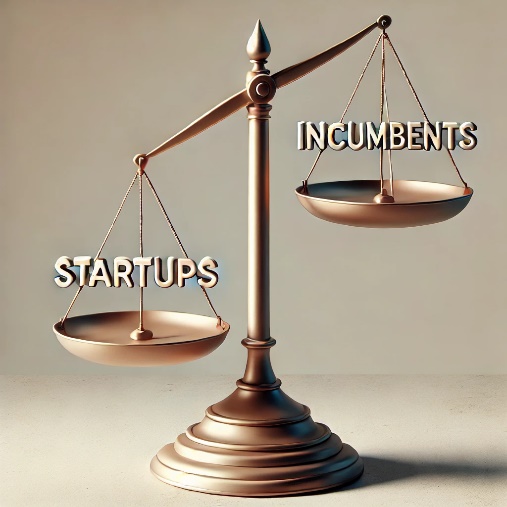
Social capital is a contestable incumbent advantage. Startups can reset the playing field with six strategies to redesign the network architecture of an industry.
Idea in Brief
- Social capital is the network of relationships that enable companies and markets to function well.
- Social capital – like financial, human and political capital – is a store of value that must be nurtured to retain value.
- Network architectures evolve with the industry lifecycle in consistent patterns.
- Startup strategies to rearchitect industry networks include market extensions, industry expansion by bridging market gaps, product led growth, crowdsourcing, and open innovation.
In 2015, thousands of taxi drivers in Paris rioted blocking thoroughfares, damaging cars, and threatening Uber drivers while seeking to ban Uber in France. City councils in San Francisco, Washington DC and New York threatened bans and fines of $5000 fine per ride for each day Uber remained in operation. Uber responded by appealing directly to its customers. The next day DC councilmembers received 50,000 emails and 37,000 Tweets using the hashtag #UberDCLove. Over 200,000 New York City customers petitioned to drop the restrictions. Both cities relented allowing Uber to continue its ride hailing service.
Social capital – not human or financial capital – decided Uber’s fate across Europe and the U.S. in those early crucible moments of ride hailing. As city council members weighed the social capital of incumbent taxi drivers versus ride hailing upstarts, Uber won by appealing to a higher authority: the residents who elected them.
Social capital is a currency used frequently in incumbent responses to disruptive startup innovation. AirBnB also survived threatened bans in San Franciso and New York City by appealing to customers after hotel operators lobbied to prevent short-term rentals. Paris banned e-scooters amid lobbying efforts by the same taxi drivers who countered Uber. TikTok survived U.S. threats to ban its service by appealing directly to its users much as had Uber and AirBnB. Apparently less attuned to its citizens, China banned Facebook, Twitter and Google years earlier citing privacy concerns in favor of TenCent and Baidu.
Social Capital: The Network Architecture of Markets
Financial capital, human capital and political capital are valued currencies among entrepreneurs. Founders need funding, talent and, often, a clear regulatory runway to launch startups.
Social capital governs ability to get things done. Social capital complements financial, human and political capital and may tip the scale for startup funding, recruiting, partnering and selling. Social capital determines competitive headwinds or tailwinds for a startup as evident in the above cases with Uber, AirBnB and TikTok.
Social capital is the network of relationships that enable companies and markets to function well. Social capital includes reputation, branding, and position within an industry. Social capital describes the network architecture in an industry forming the connective tissue and norms among customers, suppliers, employees and partners. Human capital is what you know; social capital is who you know. Like human capital, social capital is a durable asset that must be maintained and nurtured to retain value.1
Social capital has three dimensions: the (1) structural capital refers to the networks and connections showing who knows whom; (2) relational capital reflects the quality and trust within those connections; and (3) norms are the shared understandings that govern interactions. Social capital also involves three types of relationships: bonding within a group; bridging across groups; and linking across power levels.
Social capital emerges in industries as network architectures and norms evolve as markets mature. In nascent markets, networks are loosely connected with few firms as shown in Figure 1.1. Industry growth attracts more companies, suppliers, customers and investors in denser networks without any clear leader as shown in Figure 1.2. Industries consolidate and cluster around the market leader as the market matures as shown in Figure 1.3.
Figure 1: Network Architecture Evolution over an Industry Lifecycle

Social Capital and the Competitive Dynamics of Startups v. Industry Incumbents
Social capital can be a significant obstacle for startups, especially in mature industries in which incumbents enjoy favorable brand recognition and key stakeholders have clustered around market leaders. Corporate social capital heightens barriers to entry through an installed base of loyal customers, entrenched supplier relationships and channel partnerships, and preferred access to financial resources. Switching costs are high when customers have an affinity for established brands and perceive risk when considering alternative solutions. Incumbents can bundle in new services enabling rapid expansion into adjacent markets, which heightens switching costs further for narrower offerings. Corporate executives inhabit citadels offering promontory points from which they can survey the industry landscape while leveraging expertise and networks built over decades of experience. Incumbents may also leverage political capital to further entrench their competitive position, a process known as ‘regulatory capture.’
Market entry may be daunting for startups that begin with little social capital relative to incumbents. Startups rely on the founder’s personal network initially to attract stakeholders and accrue social capital slowly through customer, partner and investor engagements.
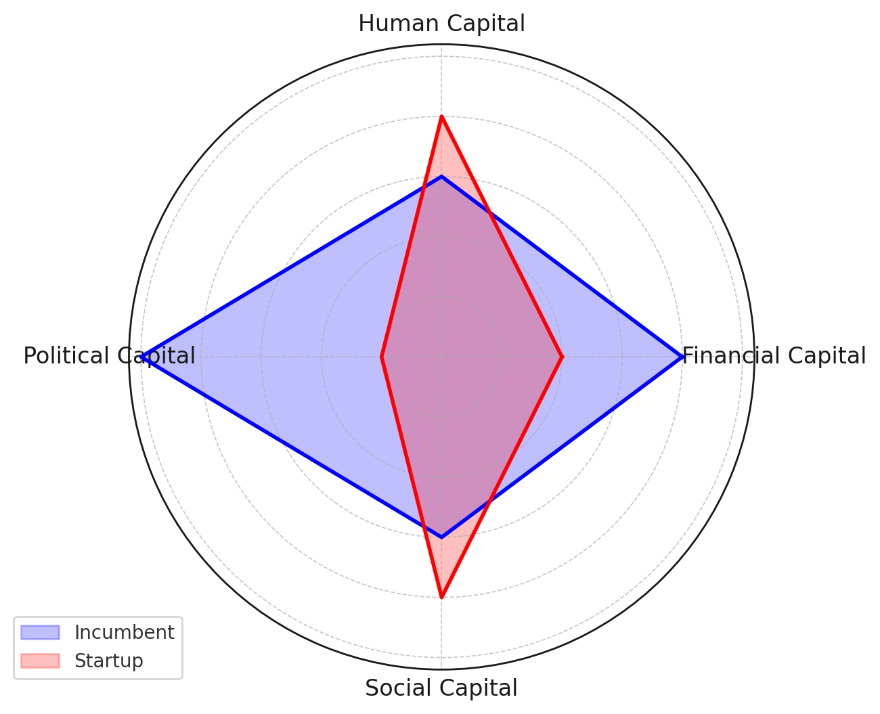
Yet startups have several options that help offset incumbent advantage. Industry outsiders bring fresh perspectives that may not be apparent to insiders. Startup agility presents windows of opportunity for newcomers in industries undergoing significant technology change. The rise of data, cloud computing and artificial intelligence has upended many traditional industries offering new opportunities for startups. Venture funding can neutralize incumbent financial resources. Figure 2 illustrates these four dimensions on which startups compete with incumbents.
Figure 2: Four Dimensions on which Startups compete with Incumbents
Six Ways Startups Can Leverage Social Capital to Outflank Incumbents
Startups need not cede social capital to incumbents, especially with disruptive ideas as generative AI converges with social media.
Startups can reconfigure network architectures to shift social capital to their advantage. While incremental innovation expands the market but preserves established industry networks, disruptive innovation may fundamentally alter social capital dynamics in an industry. Disruptive innovation rearchitects market networks upending the balance of power in an industry. For example, ride hailing not only expanded the taxi market by more than four times in cities but established a direct link to a community of customers that offset incumbent political clout within cities.
Following are six ways that entrepreneurs and startups can leverage social capital to outflank incumbents and achieve market leadership.
- Identifying Startup Opportunities: Entrepreneurial networks are a source of startup ideas. Founders of venture-backed firms typically live in tech hubs for 5-7 years before launching successful startups to tap new ideas through “knowledge spillovers” and build social capital needed to recruit talent, form partnerships and raise funds needed to scale the business. Communities of practice share complex information and tacit knowledge vital to innovation.2 Diverse networks are important as creative ideas tend to emerge from industry outsiders. In my study of recent unicorn IPOs, 62% of entrepreneurs who founded disruptive startups had no prior industry experience, while 85% of founders promoting incremental innovation came from within the industry.
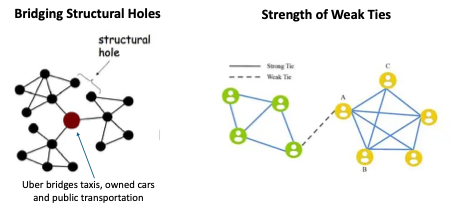
- Bridging Market Gaps: Innovation emerges at the edges of established markets enabling startups to extend into new markets or bridged gaps between two adjacent communities3. Uber expanded the ride hailing market by bridging a gap between driving, taxis and public transportation. AirBnB identified a gap between hotels and homestays. Micromobility such as electric bikes and scooters fills a gap between public transport and taxis. By filling holes in two adjacent markets, entrepreneurs can rearchitect industry networks rendering old networks obsolete. Like technical debt with the advent of new technologies, traditional industry networks seem antiquated when startups rearchitect industry networks by spanning adjacent markets or attracting new groups of users. Figure 3 illustrates the potential social capital leverage that can be achieved by bridging structural holes.
- Leveraging Weak Ties to Attract Stakeholders: Referral networks help attract investors, customers and partners. People from the same community have redundant networks that confer little added value beyond one’s personal network. The majority of new jobs come through weak ties, people who do not know us intimately but have access to networks beyond our direct reach.4 Savvy entrepreneurs leverage the “strength of weak ties” through extended networks that confer trust among potential investors, customers and partners they could not otherwise directly access. Savvy entrepreneurs give small gifts that signal respect and ignite a spirit of reciprocity that benefits both parties. Venture capital works through such warm referrals from trusted advisors to entrepreneurs. Figure 3 illustrates how the strength of weak ties can extend personal networks.
Figure 3: Rearchitecting Industry Networks: Bridging Market Gaps and Extending Markets
- Accelerating Product Market Fit: Lean startups leverage rapid prototyping to iterate quickly on user feedback from early adopters to reach product market fit faster. Online collaboration lowers the threshold for customer adoption and streamlines user feedback. Crowdsourcing and open-source software enable developers and users to engage directly in product and software development. In its early days, Lime5 did weekly A/B testing on its mobile app and monthly iterations on its scooters to increase vehicle utilization and durability. User feedback rapidly improved product design enabling Lime to scale quickly and profitability. Nimble startups are best equipped to leverage rapid prototyping and iterate quickly on user input.
- Accelerating Adoption with Product Led Growth: Despite positive feedback from early adopters, startups still must cross the chasm for broader adoption. Product led growth lowers barriers to mass adoption by leveraging social networks to accelerate growth while reducing marketing costs. Reference customers and thought leaders offer “social proof” for the benefits of new offerings while ease to use and freemium pricing lower barriers to adoption allowing users to try the product before they buy it. Expiring offers spur viral growth by creating a herd mentality and fear of missing out (FOMO) as products move toward mass adoption.
- Building Platforms Through Open Innovation: Incumbents prefer closed networks as they confer proprietary advantage to those within the network.6 But social networks are permeable enabling startups to erode the corporate walled gardens. The most valuable global tech companies today are digital platforms that promote open innovation, which includes the app stores of Apple and Google and Amazon’s ecommerce network. Open innovation enlists development and business partners to crowdsource features and services that reinforce community use. Digital platforms provide a common software infrastructure layer for software developers and ecosystem partners, which reduces development costs, aggregates data, and standardizes user engagement. Digital platforms enjoy significant network effects, which offset traditional incumbent advantages.
Social capital reflects a firm’s brand and reputation. Social capital complements financial, human and political capital while providing the glue that affirms loyalty among customers, employees, suppliers and investors. With the six strategies outlined above, startups can reengineer the network architecture of an industry, offset inherent incumbent advantages, and leverage social capital to accelerate growth.
Best wishes in building your social capital and achieving all your summits!
Related Concepts
Social Capital is often more valuable than physical capital in digital industries. Open Innovation can accelerate construction of digital platforms by leveraging Crowdsourcing and Network Effects. Viral Marketing accelerates growth and reduces Customer Acquisition Costs by leveraging Social Proof to create a Herd Mentality a Fear of Missing Out (FOMO). Weak Ties are often more effective referral sources as they extend networks more than strong ties.
-
For more background on social capital, see Adler, P., Kwon, S. (2002). Social Capital: Prospects for a New Concept. ↑
-
See Wenger, E. (1998). Communities of Practice: Learning as a Social System for a detailed account of how communities of practice work as a catalyst for innovation. ↑
-
See Burt, R.S. (2004). Structural Holes and Good Ideas. See also Landry, R., Amara, N., & Lamari, M. (2002) for a case study in Montreal. ↑
-
See Granovetter (1973). The Strength of Weak Ties. ↑
-
Disclosure: NGP Capital is an investor in Lime. ↑
-
Walker, G., Kogut, B., & Shan, W. (1997) make the case for the benefits of closed networks rather than open networks. Chesbrough, H. (2003). Open Innovation: The New Imperative for Creating and Profiting from Technology is an early and widely followed advocate of open innovation. ↑