Social Capital: The 10X Multiplier on Human Capital

Paul Asel
Founding Partner at NGP Capital·
Social capital creates outsized returns on human capital by altering network architectures. We discuss twelve strategies to enhance personal social capital in business and life.
Idea in Brief
- Social capital augments human capital to define potential.
- Character is currency as reputation determines social capital while networking extends depth, breadth and centrality.
- Our twelve strategies to enhance social capital derive from four expert observers and observations from over one hundred successful entrepreneurs.
When ChatGPT launched in November 2022, Chappy Asel gathered a dozen of us in a cozy San Francisco apartment to discuss potential uses of generative AI, from which a couple of venture-funded startups emerged. The AI Collective was born a few weeks later when over 250 people signed up for a similar discussion. From that humble beginning, the AI Collective has grown within three years to over 250,000 members with 150+ chapters across 40+ countries, hosting 1,000+ events annually with daily newsletters, weekly podcasts, and a research institute active in DC working with industry-leading companies to advocate for responsible AI.
When Paul Asel cofounded NGP Capital in 2005, the same social capital principles applied to drive branding and gather adherents though the technology and topics differed. NGP Capital established global thought leadership in mobile technology publishing monthly insights and hosting four annual conferences that gathered thousands of entrepreneurs and industry executives and over 100,000 simultaneous online viewers. NGP Capital pioneered the global venture model with $1.7 billion assets under management leveraging pattern recognition to make early-stage investments in sixteen future unicorns across the U.S., Europe and Asia.
Social Capital: The 10X Multiplier on Human Capital
Social capital augments human capital to build financial capital. Ambition defines how far you would like to go. Human and social capital determine how far you can go. Human capital (what you know) and social capital (who you know and for what you are known) determine your ability to get things done. Human capital without social capital is an underutilized asset: knowledge must be acknowledged to have value.
Social capital has three dimensions: (1) network breadth; (2) network quality; and (3) reputation, which affects the latent value of untapped networks. Social capital, like human capital, is an asset that must be nurtured and maintained to retain value.
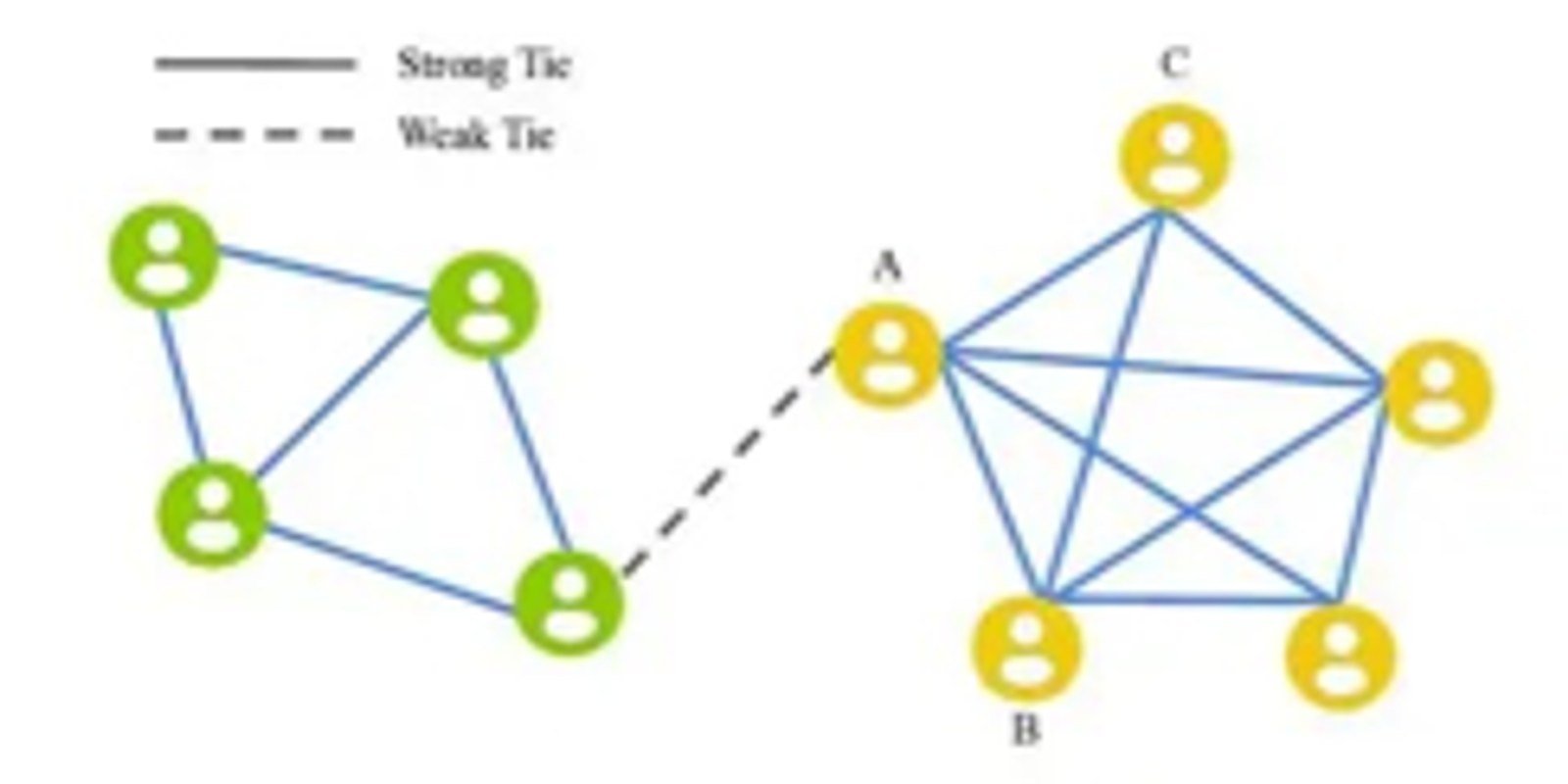
The importance of social capital is manifest through the strength of weak ties. Strong ties are those within our network, while weak ties are referrals received from those within our direct network or through loose connections made online or at networking functions. Weak ties extend our networks and are the source of most new jobs and partnerships, but they do so only if reputations remain intact.
Figure 1: The Strength of Weak Ties
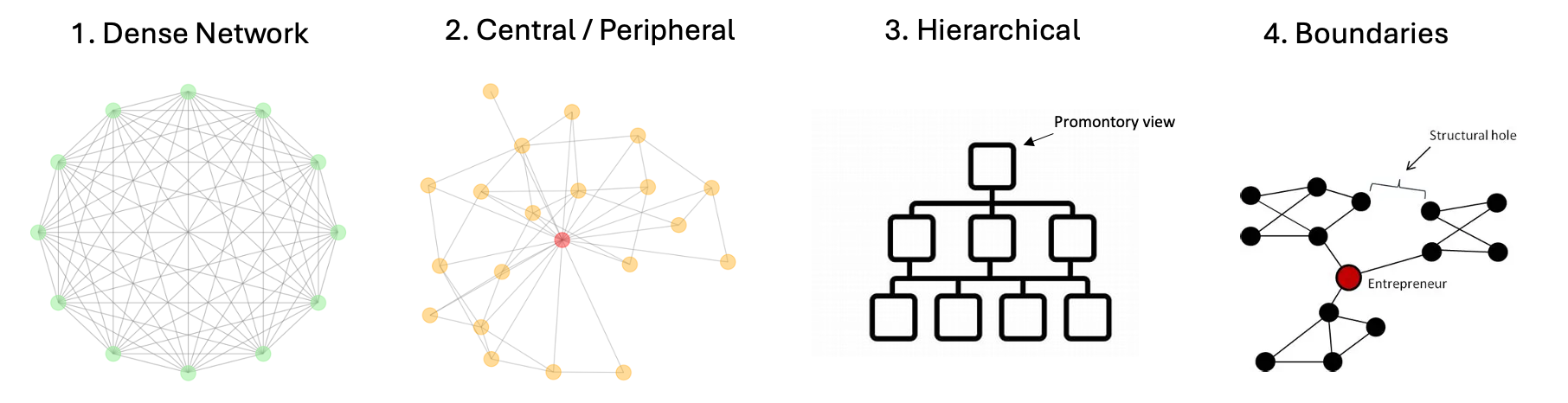
Network quality depends on network architecture. Network density is conducive to intimate, high-frequency interactions vital for building trust and sharing nuanced, complex information that lead to startup opportunities. Network centrality offers access to many connections and lots of information, while network periphery offers more perspective. Promontory positions in hierarchical networks enable both perspective and access to much information.
Networks reduce transaction costs and enhance trust through rules, regulations, codes of conduct and culture. Network boundaries involve signaling that defines in-groups and out-groups. Network effects enable winner-take-most markets by increasing value to those within the network while reducing acquisition costs of admitting new members. Open networks have lower entry requirements, more flexibility and adaptability, while closed networks maintain exclusivity through rule enforcement and barriers to entry.
Social capital may be measured by the ability to strengthen networks within groups and fill gaps by bridging across networks. Connectors can play three important roles within networks: they (1) enhance bonding within groups; (2) facilitate bridging across groups; and (3) enable vertical linking within hierarchies. Entrepreneurs expand markets by bridging structural holes across user groups or geographic boundaries as illustrated in figure 2.
Figure 2: Network Architecture – Density, Centrality, Peripheral v. Promontory Views, Boundaries
Social capital extends beyond professional activities to friends, family and community. If a long, happy life is our ultimate objective, social capital matters more than wealth or human capital. Wealth and happiness are largely unrelated beyond a subsistence level. The Harvard Study of Adult Development, which has spanned nearly 80 years, finds that relationships and community engagement influence life longevity more than almost any other factor. The Jewish saying “life is with people” resonates more than scientists may have initially appreciated.
Twelve Practices to Augment Social Capital
There is no single formula for building social capital. Technology and preferences change constantly, so what worked last year may not work now. Personal proclivities differ and being authentic is essential, so strategies should be customized to your audience and predilections.
The following practices draw from our research and experience working with and observing many effective entrepreneurs. For further insights on social capital, consider the following books: (1) Never Eat Alone by Keith Ferrazzi, (2) _Unreasonable Hospit_ality by Will Guidara, (3) The Serendipity Mindset by Christian Busch, and (4) Mass Appeal by Justin Gest. Parenthetical references below indicate that one of these books inspired that point.
1. Character is Currency
Reputation is our most valuable asset. Trust takes decades to build and five minutes to destroy. Lawyers advise one to stay well within the foul line, but doing the right thing is a higher standard. Online media has increased reach and shifted social capital toward network breadth, but reputational currency risks devaluation when the quest for volume supplants quality. A useful litmus test: does this align with how I want to be known? Your public persona, online and off, should reflect the values and brand you are building.
2. Never Eat Alone
Social capital, like financial and human capital, is an investment that compounds over time when nurtured and maintained. As James Clear writes in Atomic Habits, "we do not rise to the level of our goals but fall to the level of our habits." Never Eat Alone reminds us to invest daily in social capital. Set ambitious goals and track your progress toward these objectives. Consider building your own relationship management system much as any firm does for their key stakeholders. Ferrazzi keeps a database with three tiers of relationships: the first for monthly contacts, second for semi-annual or annual contacts, and the third for ad hoc outreach. Focus on relevancy and intimacy with each outreach, using this as an opportunity to catch up on their content.
Agentic CRMs and AI-powered outreach tools now make it possible to maintain relationships well past Dunbar's 150-person limit, automating personalized touchpoints, surfacing timely reasons to reconnect, and tracking relationship health across hundreds of contacts. The underlying loop compounds: content creates engagement, engagement builds relationships, relationships generate introductions, and introductions create opportunities that fuel more content. Each cycle strengthens the network.
3. Fortune Favors the Prepared Mind
Social capital leverages human capital. Build expertise by focusing on a narrow but meaningful niche and being the best in that category (2). Building social capital has two phases: apprenticeship to develop expertise and leadership when marketing expertise. During the apprenticeship period, networking with experts accelerates learning. The best mentees find ways to give back more than they receive. Mastery confers the right to win within your area of expertise during which one converts human capital into social capital as discussed below.
4. Serendipity Mindset
Serendipity involves more than blind luck. Savvy promoters engender luck (3). In Great by Choice, the authors describe a 10X Luck Multiplier effect in which some firms seize a higher return on luck than others even when luck is evenly distributed. Networking expands your Luck Surface Area, increasing exposure to people, ideas, and unexpected collisions that create opportunity. Alertness, adaptability, initiative and a positive outlook are foundational skills both in tapping serendipity and building social capital.
The AI Collective demonstrates this principle at scale. Serendipity abounds when velocity meets density with thousands of builders, researchers, and operators gathering weekly in cities around the world. Intros turn into hires, conversations into collaborations, and concepts into breakthroughs in gatherings where ideas and people collide. Exercise audacity in outreach: a "no" is the worst-case scenario, and you miss every shot you don't take (1).
5. Start and End Well
All interactions matter but some matter more than others. First impressions set the tone, and many meetings are effectively over in the first five minutes. The “peak-end rule” suggests the conclusion has a profound effect on how we remember interactions. The objective for first meetings is usually to establish a basis to continue the relationship rather than close a sale. Focus on building rapport and establishing credibility in the first five minutes, emphasizing shared interests and connections based on your prior research. End on an affirmative high note while agreeing on next steps if appropriate. Follow up within 24 hours with a thank-you note and a personal reflection from the conversation (1). Set reminders to follow up later if appropriate. It is remarkable how rarely people do this and its positive impact when done well.
6. Don't Keep Score
Networking is about generosity, not scorekeeping. Trust follows the GVAC formula: generosity, vulnerability, accountability and candor (1). Provide value and pay it forward broadly. Connect people proactively. Giving small gifts is a delightful custom in Asian business; adopting this custom stands out more in the West. Reciprocity creates compounding returns.
7. Be Colorful! Be Exothermic!
In Unreasonable Hospitality, Guidara applies a 95/5 rule to restaurants: be cost conscious on 95% and lavish on 5%. The 5% applies a “Be Colorful!” principle observing that service is black and white, but hospitality is colorful. With its motto Be Exothermic!, SVT Robotics recognizes the outsized impact of radiating energy and enthusiasm. Both SVT and Guidara recruit for energy and tap social arbitrage – the outsized and lasting benefits of creating a great impression – as people may forget what they ate but will never forget how they felt. Those who make truly great first impressions are indelibly etched with warm sentiments even decades later such as when an entrepreneur met me unannounced when I arrived at the Bangalore airport at 3am. Be exothermic always and dare to be colorful when it matters!
8. Lead with Authenticity
Bring your whole self. The people who build the deepest social capital establish trust through consistent authenticity, which extends beyond personal practice to the conditions you create for others. Showing up without pretense gives others permission to do the same. The AI Collective built its culture on five core values: connection, positive thinking, authenticity, participation, and curiosity. These values create a safe environment to be honest ask penetrating questions such as "how will my role change in a world transformed by AI?" Psychological safety facilitates the kind of trust that produces co-founders, lifelong collaborators and transformative ideas.
9. Build Your Public Brand
Your personal brand is what people say about you when you are not in the room. Be unique, be yourself (1,2). Branding derives from excellence in an area and how you market it. Consistency drives familiarity with the same message, values and tone across every touchpoint.
Great communicators use spaced repetition to reinforce their message: tell them what you will tell them, tell them, then tell them what you told them. Multichannel distribution does something similar, repackaging content for different media to reach a broader audience and reinforce the original message. To become king of content (1), one must master a medium (4) as the medium is the message. Audiences reward media mastery as evident by U.S. presidential history: Theodore Roosevelt mastered railroad networks with his whistlestop tours; Franklin Delano Roosevelt mastered radio with his fireside chats; a telegenic John F. Kennedy mastered television; Obama built his following on the Internet; and Trump mastered Twitter (now X).
Personal branding is strategic positioning, not self-promotion. Frame your wins as value creation for others. Pick two or three content pillars you use consistently and build a compounding body of work. The underlying flywheel is powerful: content creates engagement, engagement builds relationships, relationships generate introductions, and introductions create opportunities that fuel new content. Each flywheel revolution strengthens your brand and network concurrently.
10. Create Rituals
Rituals turn sporadic activity into cherished traditions. Quarterly newsletters to your personal network, hosted dinners when traveling, annual gatherings that become can't-miss events, birthday messages, handwritten holiday cards. Repetitive activities create touchpoints that compound over time as people anticipate and value the ritual.
The power of rituals is rhythm. A monthly dinner with a small group of peers builds more trust over two years than dozens of one-off coffee meetings. Quarterly personal updates maintain relationships and offer opportunities for more contextualized follow ups. Rituals also signal commitment: showing up consistently, year after year, communicates that the relationship matters beyond any single transaction.
11. Convening Power
Being a recognized expert with a broad network conveys convening power. The AI Collective established convening power in artificial intelligence starting from a dozen people around a table in a San Francisco apartment to over 250 signups a few weeks later with no marketing grow to 150+ chapters hosting 1,000+ events annually. Start by volunteering to organize part of an event that showcases your expertise. Then curate your own networking events however small at first, especially in rapidly evolving areas where information is sparse. Insight that is not readily available in other forums reinforces your reputation and expands the network.
12. Strength of Weak Ties
We discussed three types of connections: bonding within groups, bridging across groups and linking across levels. Networking tends to focus on activities within communities of practice, but nurturing weak ties requires reaching across boundaries. Convening power offers opportunities to bridge gaps and assemble diverse groups who enrich discussions with varied perspectives. Peripheral members are often well positioned to bridge gaps, but connectors can help close them. Get to know connectors in other circles. The action often happens at the edges, and bridging gaps builds social capital while presenting entrepreneurial opportunities. Use an Impact-Effort Matrix to allocate your time wisely among these many discretionary activities, focusing energy on high-impact opportunities first.
Consider this a starter kit rather than an exhaustive list. Social capital has many dimensions and is a discretionary activity, so find a mix that is authentic to you and fits your interests and time availability.
Regardless of how you approach social capital, have fun and be exothermic! Life is with people!
Related Concepts
Atomic Habits reminds us that we do not rise to the level of our goals but fall to the level of our habits. Networking expands Luck Surface Area by increasing exposure to serendipity. Paying it forward builds trust and encourages reciprocity. The Impact Effort Matrix helps allocate time and effort among many discretionary alternatives.