TAM and its Many Misuses: Assessing Opportunity in Nascent Markets

Paul Asel
Founding Partner at NGP Capital·
TAM can be a valuable tool for founders, but it is often misused. TAM helps founders assess market potential and expand startup opportunity over time.
Idea in Brief
- TAM measures how much all potential customers will pay for a product or service. But TAM is speculative in nascent markets. The Gartner Hype Cycle is built on inflated expectations suggesting that TAM contains more noise than signal for startups pursuing unproven markets.
- TAM may be known, emerging or invisible. TAM evolves with industry lifecycles and becomes more known as markets mature. Entrepreneurs expand TAM with product extensions into adjacent markets.
- TAM may be assessed through first principles thinking or customer experience. Defining TAM helps founders understand industry structure, develop strategy, assess founder market fit, and pivot quickly to achieve product market fit.
What is your TAM?
TAM – the Total Addressable Market – indicates market opportunity and tells founders and investors whether a startup is worth pursuing. TAM also indicates founder ambition. No article or funding pitch seems complete without reference to TAM.
Yet TAM is speculative for early-stage markets. Most iconic startups emerge from nonexistent markets where traditional methods for assessing market opportunity are of little use. If Heny Ford had asked customers about transportation needs before the invention of the automobile, they may have asked for faster horses. Computers, the Internet and smartphones seem indispensable today, but they were not missed before they existed.
We launched NGP Capital to invest in smartphone startups in 2005, two years before the advent of the iPhone. Few anticipated that smartphones would make possible companies like Airbnb, DoorDash, Instagram, King, Lime, Spotify, Stripe, Supercell, TikTok, Uber, Venmo, Waze, WhatsApp and Zynga. Nor would consumers have anticipated Amazon, Alibaba, Facebook, Google, Netflix, Nvidia and TenCent at the dawn of the Internet.
McKinsey projects TAM for AI at $4.4 trillion, which dwarfs smartphones and the Internet and is over five times larger than the global software market today. OpenAI and Anthropic are foundational firms that affirm the potential for AI, yet the next generation of iconic startups for AI applications remains unclear.
I am deeply skeptical of TAM as it is commonly used. Savvy investors ignore quoted TAMs, which contain more noise than signal through a hyperbolic cabal among consultants, media and promoters. Consultants compete for attention in bidding contests to quote the highest number referenced by the media. Entrepreneurs compound these inflated numbers by quoting TAMs for the entire industry rather than their target market segment. While consultants and media are rarely held accountable for their eye-watering predictions, entrepreneurs and investors pay for TAM disillusionment through carnage left in the wake of the Gartner Hype Cycle built on these inflated expectations.
TAM deserves better treatment. A useful tool when applied properly, TAM derives value through the testable assumptions that comprise the model rather than the headline number. Testable TAM assumptions provide early indicators of business potential enabling the startup to pivot as needed to pursue larger opportunities. Founders and investors should thus ignore TAM media estimates and develop their own assumptions for their target markets.
Customizing TAM requires more initial work but ultimately improves startup outcomes. The following TAM frameworks may guide this customized process.
TAM v. SAM: Known, Emerging and Invisible Markets
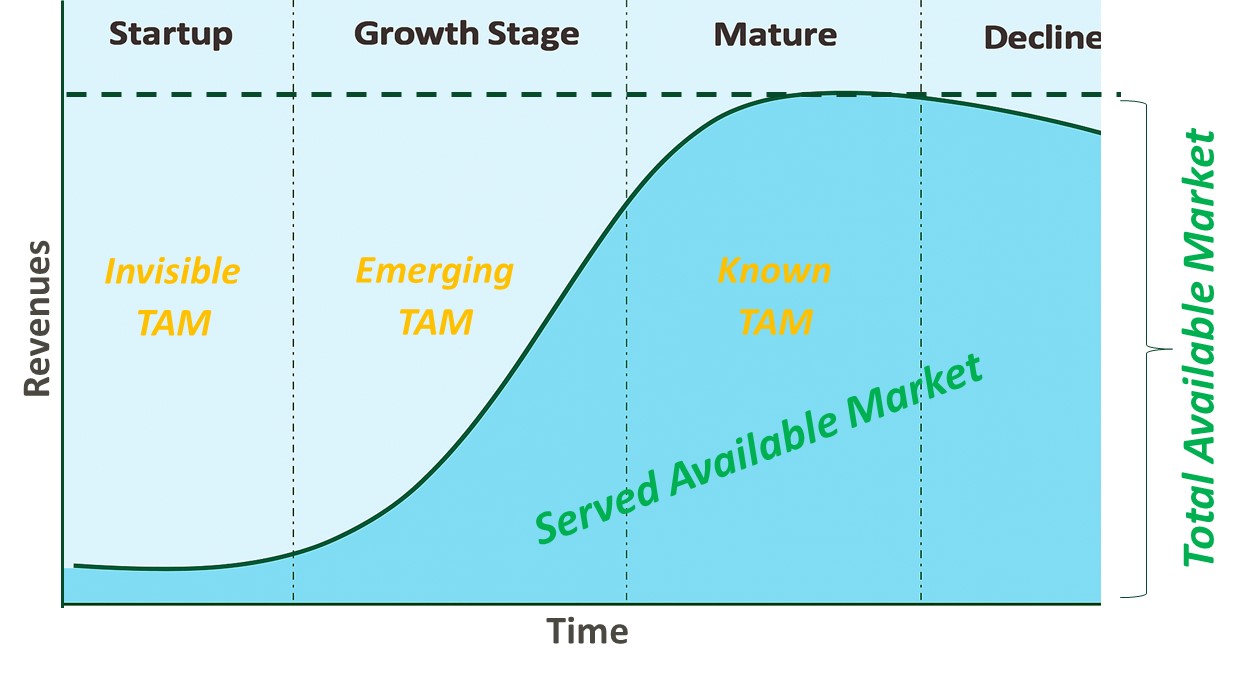
TAM comes in three buckets: known, emerging and invisible, which evolve with the industry lifecycle as indicated in Figure 1. TAM is rarely known or well understood in early venture funding rounds when industries are nascent.
Known TAM is SAM, which refers to proven customer demand in Served Available Markets. Markets where TAM is known is the province of private equity rather than venture capital. Entrepreneurs may still find opportunities in maturing markets by targeting underserved market segments reflected in the difference between SAM and TAM. Known TAM may also be a target for incremental innovation with improved services that seek to syphon market share from existing customers. Assessing TAM for incremental innovation is easier as pricing and demand are already established in largely served markets.
Figure 1: TAM v. SAM in the Industry Lifecycle
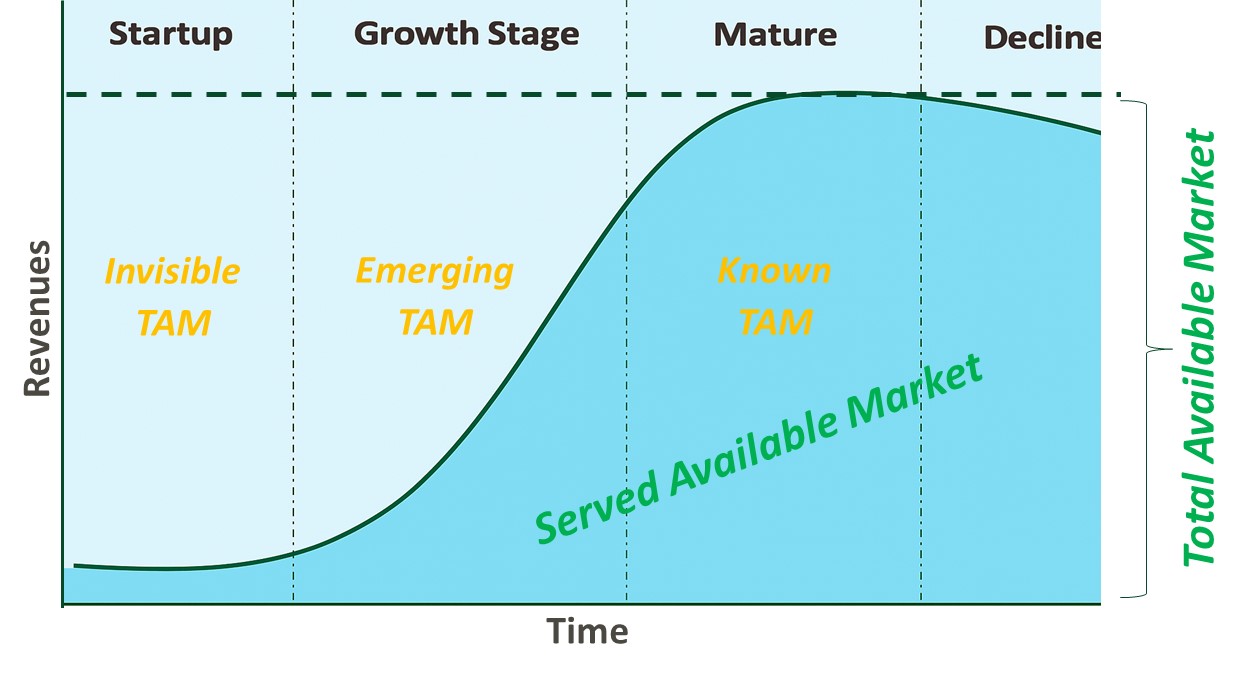
Emerging TAM provides early indicators of market potential based on initial customer traction during the growth stage of an industry lifecycle. Emerging TAM offers a sense of the market opportunity but may overstate or understate TAM as both the product and market evolve. Emerging TAM may erode and overstate TAM when customers churn out of the market, prices decline with higher volumes, or early adopters belie the interests of the broader pool of potential customers.
Emerging TAM understates TAM when entrepreneurs develop new products that extend use cases and tap new market segments. Amara’s Law observes that we tend to overestimate the effect of new technologies in the short run and underestimate the effect in the long run. History offers many examples of understated TAM. DEC founder Ken Olsen dismissed personal computing, but advancements in semiconductors and software made Bill Gates’ vision of a computer on every desktop a reality. AT&T dismissed the mobile market, but smaller form factors and more compute power enabled Nokia to put mobile devices in every hand.
Artificial intelligence has shown promise yet McKinsey’s ascribed Emerging TAM of $4.4 trillion may be overhyped or understated. Much as the current leaders did not exist when DEC and AT&T dismissed computers and smartphones, the future leaders in AI likely remain invisible to us today.
Invisible TAM is unseen and not well understood in markets that do not yet exist. While Emerging TAM involves uncertainty and variability, Invisible TAM involves latent demand, which may remain elusive or be far greater than initially anticipated. As Figure 1 illustrates, the gap between TAM and SAM increases at earlier stages of the industry lifecycle. TAM is invisible where SAM is nonexistent when disruptive startups seek seed funding.
Founding a startup pursuing Invisible TAM is a precarious undertaking. Few of these startups strike oil on the first drilling. Among successful disruptive startups that have gone public, over half pivoted and nearly half had difficulty raising seed funding. Investors dismissed early versions of Uber and AirBnB, for example, as they pursued niche markets with unrefined products before unlocking massive market demand by tapping latent demand not well served by taxis and hoteliers.
Situations involving Invisible TAM offer founders the broadest scope to define market terms both for customers and investors. Lofty visions supported by insight and well supported assumptions enable entrepreneurs to tap latent TAM in emerging and invisible markets.
Assessing Opportunity in Invisible and Emerging Markets
TAM reflects potential revenue from potential customers for a product or service. TAM informs business strategy, product requirements and financial projections. Investors can cross reference assumptions across business, product and financial plans for different lenses on market opportunity.
TAM definitions give insight into both the market opportunity and founder. How founders describe their target market illuminates the scope of founder ambition and the rigor with which they have considered product variations required to serve those markets.
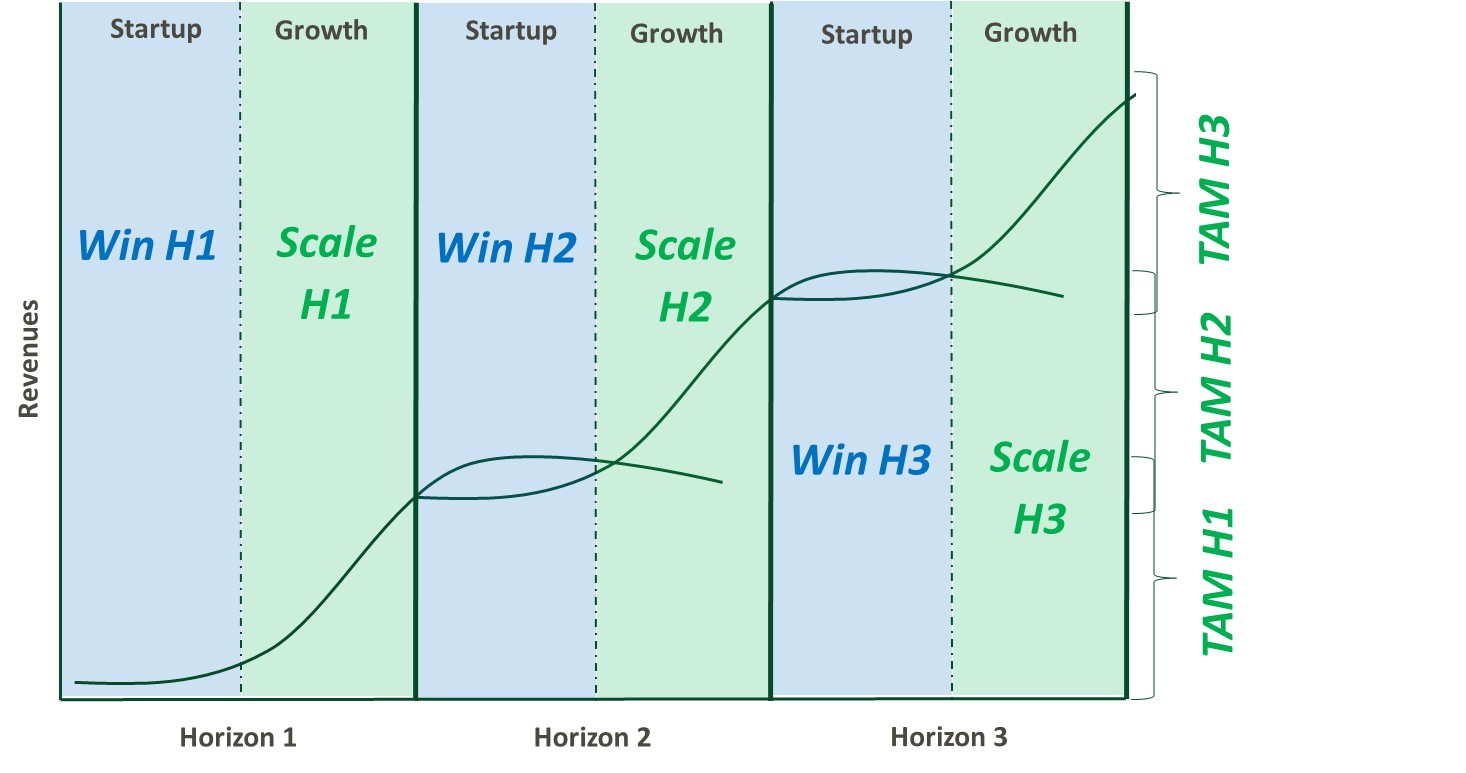
Founders may balance breadth of vision and focused execution through a multistage process in which founders focus on winning a market segment then extend the product to adjacent markets. Successful startups establish beachheads in core markets then offer product extensions to expand into adjacent markets. Through such iterative strategies, successful firms may ultimately serve TAMs that dwarf their initial TAMs. Figure 2 illustrates how successful startups expand TAM over a Three Horizons Model and how TAM may differ in the short, medium and long terms as startups win their core markets and extend into adjacent markets.
Figure 2: Iterative Win-Scale Strategy to Expand TAM over Horizon 1, 2 & 3
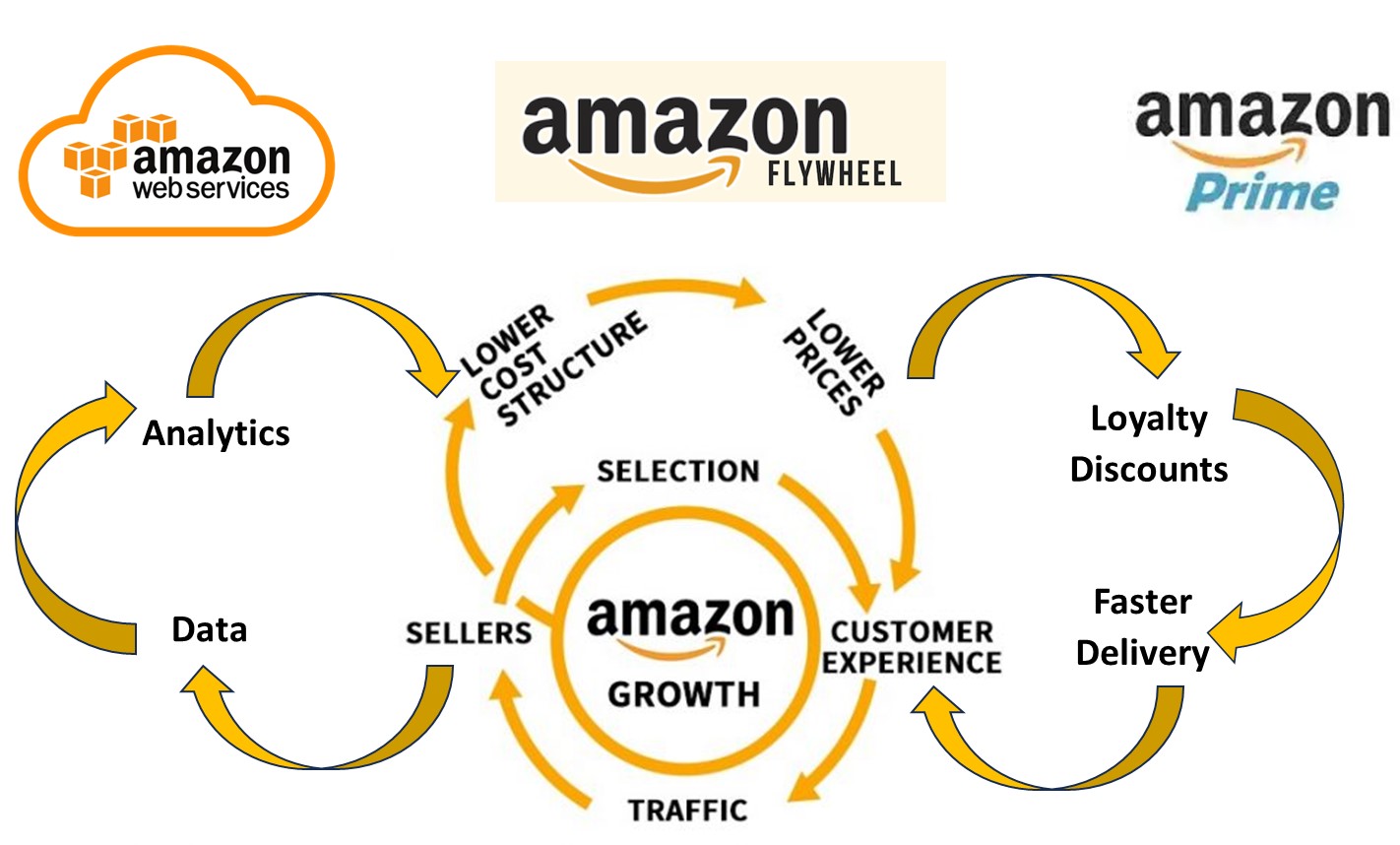
Amazon has used this iterative approach to become one of the world’s largest companies from its humble start as an online retailer of books. Once it became the leading online bookstore, Amazon expanded into digital books then broadened its online offerings to become the digital everything store. Amaonz leveraged its lead in ecommerce to offer web hosting (Amazon Web Services or AWS), logistics fulfillment services (Amazon Prime), and traditional retailing. Each of these new services significantly increased TAM while reinforcing Amazon’s original flywheel and building moats around its core e-commerce business through lower cost structures and enhanced customer loyalty. Amazon’s Day One mentality published annually in its letter to shareholders reinforced a culture that enabled Amazon to extend its business over time.
Figure 3: Amazon Flywheel Extensions into AWS and Prime Delivery
Invisible TAM may be illuminated through First Principles Thinking, which dissects complex problems into smaller and more manageable components. Elon Musk used First Principles Thinking to conceive and launch SpaceX, Tesla, OpenAI, Neuralink, The Boring Company and Zip2. First Principles Thinking offers insights into technology requirements and TAM components that informs business strategy.
Many successful entrepreneurs begin as lead users of their service. Lead users identify a market gap, which offers a glimpse into Invisible or Emerging TAM. Early adopters validate initial demand and help refine the product, revenue model and go-to-market strategy.
Entrepreneurs who define TAM through a deductive approach that identifies target customers and their needs may use the same process to accelerate the path to Product Market Fit. Firms achieve Product Market Fit by developing a repeatable business that serves customers with a common product, revenue model and go-to-market strategy. Assessing TAM and underlying market structure helps entrepreneurs anticipate competitive dynamics, market requirements, timing and capital requirements, and market share achievable given industry dynamics.
Assessing TAM helps both founders and investors assess whether, and under what conditions, an opportunity is worth pursuing. Time spent defining TAM is a good investment to ensure the prize is large enough for entrepreneurs to commit time, talent and treasure to the endeavor.
While Invisible or Emerging TAM estimates are speculative, insights garnered through the process of assessing market opportunity is more important than the headline TAM amount. This exercise can help founders assess customer requirements, anticipate unit economics and provide early indicators whether the business is on track or must pivot to achieve the scale and profitability initially anticipated.
Related Concepts
The dimensions of TAM – known, emerging or invisible – depend on the Industry Life Cycle as the gap between TAM and SAM narrows as an industry matures. TAM may refer to a specific market segment or the broader universe of customers. For early stage startups pursuing a beachhead strategy, it is most useful to consider the TAM of a targeted market segment and then expand TAM across a Three Horizons Model leveraging a Flywheel strategy to extend into other markets.
Industry structure may alter TAM through pricing and unit economics. Industry structure also informs founders about Key Success Factors, Economies of Scale and Critical Mass requirements, and achievable market share. These factors anticipate capital intensity and what is needed to achieve Escape Velocity. The Five Forces Model and Value Chain help anticipate industry structure for early stage markets. Winner Take Most Markets may be most capital intensive but will enjoy higher profit margins for market leaders.
Invisible TAMs raise questions embedded in the Johari Window such as uncovering blind spots and anticipating unknown unknowns. Large TAMs may help establish a vision or BHAGs for the business but should not distract from fundamental business model questions. Entrepreneurs should use the TAM exercise to think carefully about Right to Win, Product Market Fit and Founder Fit.