The Product Market Fit Playbook: Seven Practices That Drive Startup Success

Paul Asel
Founding Partner at NGP Capital·
Paul Asel
Product Market Fit progresses through three phases: product, business and financial validation. A Product Market Fit playbook improves startup success by accelerating progress through these stages.
Idea in Brief
- Product Market Fit is not a binary threshold. Success rates double at each level from product and business to financial validation.
- Startups should stay lean and agile until business validation and then scale thereafter.
- The Product Market Fit playbook coincides with the financial plan as resource requirements, key success factors and operating metrics adjust with product, business and financial validation. The Board should review the PMF playbook with the financial plan during annual budgeting.
“We don’t have product market fit.”
The Board room fell silent. How could a growing company – let’s call it PMF Misfit – with $50M revenues in a hot category not have product market fit? PMF Misfit had raised over $100M yet lack of product market fit imperiled the business.
Product market fit is the holy grail for startups and venture investors. Marc Andreesen from Andreesen Horowitz describes product market fit as the only measure that matters for early-stage startups. Product market fit demarcates startup strategy: adding resources before product market fit slows a startup down; adding resources after product market fit accelerates growth. Founders declare product market fit, often prematurely, in their rush to raise funding to fuel growth. But premature attributions of product market fit imperil startups as more companies die of indigestion than starvation.
Yet product market fit is a vague and often misunderstood term. Andy Rachleff from Benchmark Capital coined the term and defined it as: "a unique product offering that people desperately want." This aspirational definition is catchy and conveys a clear objective, but it is not actionable and leaves much room for interpretation. Later definitions indicate that “product market fit is achieved when a product addresses a genuine need for a specific customer group, resulting in regular use and a willingness to pay.”
Product market fit is not a singular binary threshold as many founders and investors presuppose. No pearly gate demarcates pre and post product market fit. No smoking starting gun invites lean startups to throttle up and accelerate around the racetrack. Products rarely transform from molasses to buttery in a single version. Skeptical customers do not convert to desperately wanting a product overnight. But startups may follow a consistent playbook that augments startup success along the path toward strong product fit.
Our research observes three stages of product market fit: (1) Product Validation during which the product is refined through feedback from early adopters; (2) Business Validation during which a startup hones its business model and go-to-market strategy to reach mainstream target customers; and (3) Financial Validation during which the company proves it can scale the business profitably. Andreesen Horowitz has acknowledged multiple thresholds distinguishing between product user and product market fit, which mirrors the distinction between product and business validation. The traditional product market fit threshold when customer traction accelerates occurs during business validation.
Across over 100 investments and 50 exits at NGP Capital, we found that companies with Product Validation ultimately have a 25% success rate delivering attractive returns for investors and founders. Companies with Business Validation and Financial Validation have 50% and 90% success rates, respectively. We thus describe these three stages as weak, medium and strong product market fit.
Business requirements shift significantly at each stage. Our data suggests that no more than half the startups that surpass one level succeed at the next stage, yet investors and executives can increase success rates by following a consistent step by step process illustrated in Figure 1.
Figure 1: Three Business Stages and Nine Steps to Strong Product Market Fit
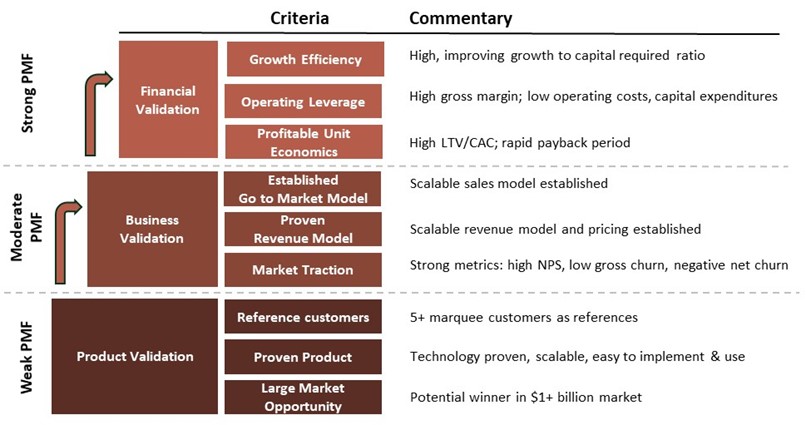
Product validation affirms with early adopters that the technology works, is easy to implement and use, and is scalable. Investors typically require product validation from five or more reference customers with consistent needs suggestive of broader customer demand. Founder outreach to early adopters can achieve product validation prior to recruiting a dedicated sales team. Early signs of product validation include consistent demand for a standardized product, high and growing user engagement, modest maintenance requirements, and affirmative Net Promoter Scores from early customers.
But early product validation often proves illusory. Early adoption from reference customers may require startups to do things initially that are not scalable. Startups may overengineer products, for example, with customizations required by early adopters. Enthusiastic early engagement may subside as users move on to more shiny trinkets. Early customers may ultimately prove burdensome and vestigial as the product pivots to attract target mainstream customers. Early-stage startups often tout evidence of early demand, yet later experience customers churn as the market advances, their client champion moves on, or the product provides insufficient customer value.
PMF Misfit experienced stellar growth doubling or tripling revenue in the early years. Funding poured in at valuations approaching unicorn status at $1 billion. But product customizations demanded by clients extended implementation cycles and increased product complexity. While customer references and independent market research validated its superior technology, PMF Misfit looked more like a service than product company.
Product market fit correlates with revenues, but as PMF Misfit illustrates, growth can be misleading and unsustainable. A high-touch sales motion with customized products may build revenue but is not scalable and belies product market fit. PMF Misfit beat aggressive revenue forecasts in each of its first four years while winning marquee accounts. But long sales and implementation cycles were harbingers of slowing growth and customer churn. PMF Misfit missed its revenue forecast in the fifth year as customer churn offset new sales. PMF Misfit fired its Chief Revenue Officer, who too often takes the fall when products and markets misalign. It was just the first of five CROs recruited to solve a problem that resided deeper within the company.
Business validation is the stage during which startups seek to convert early reference customers into reliable and growing demand from mainstream target customers with a standardized product, consistent business model, and scalable go-to-market strategy. During this stage, startups refine their value proposition and target customer profile, standardize products for mainstream customers, experiment with pricing strategies, extend direct selling efforts, and explore channel partnerships.
Business validation is evident through Product Led Growth when sales shift from push to pull as inbound customer interest spurs growth without outbound sales or marketing. Declining operating cost per active user is a leading indicator of product standardization. Key metrics that measure business validation include accelerating sales and implementation cycles, low customer churn, increasing customer usage and revenue per customer, and high Net Promoter Scores.
Business validation is the point at which a company shifts from winning to scaling as illustrated by the Bain Win/Scale model in Figure 2. Business validation may coincide with a Dominant Design indicating that customers have coalesced around consistent product features that any company must satisfy to win the market. Once a company achieves business validation or the market settles on a dominant design, the race is on to accelerate sales, win market share and achieve market leadership. Startups must build sales and operations to accelerate growth, yet adding resources prior to this point risks encumbering the business by expanding prematurely.
Figure 2: Bain Win/Scale Model – Two Distinct Startup Phases Once in Market
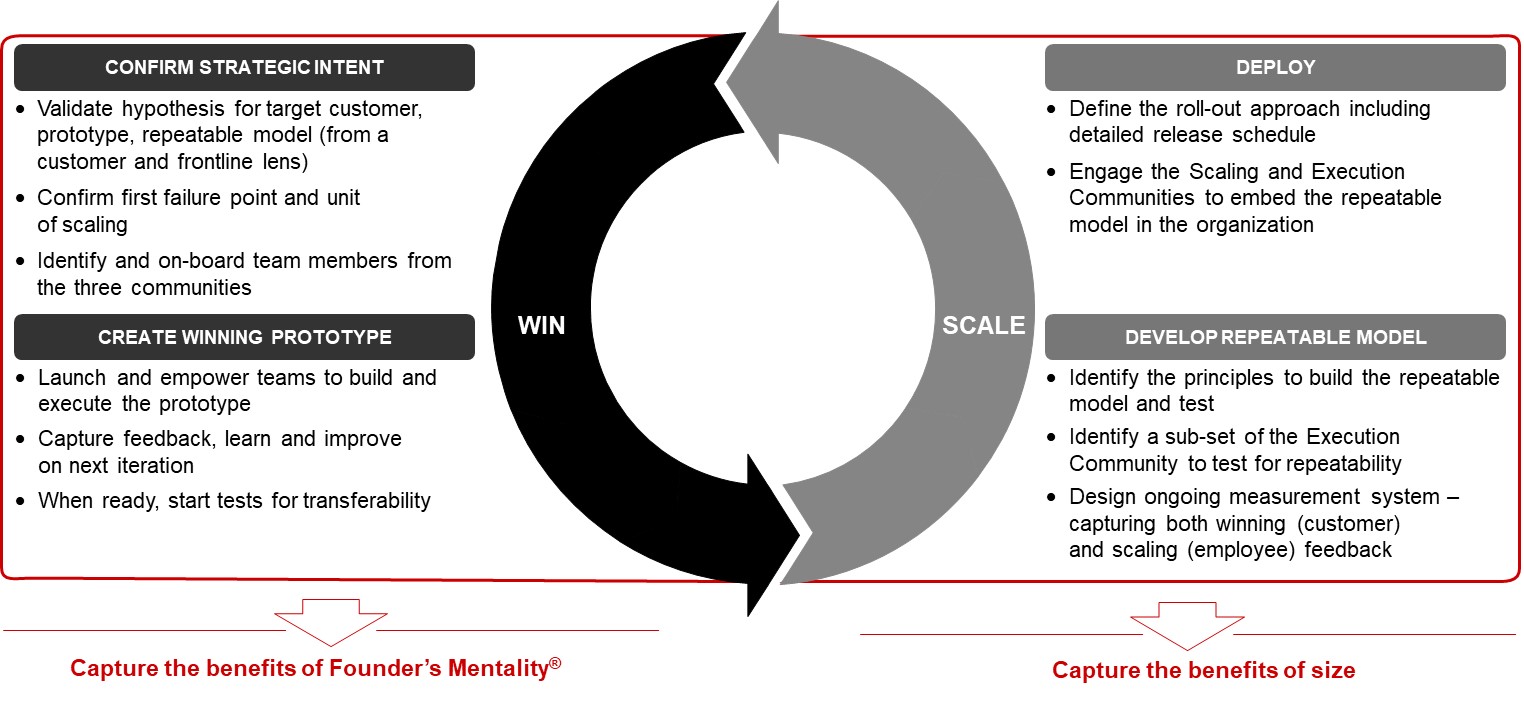
Source: Bain and Company
Recognizing lack of consistent customer demand for a standardized product, PMF Misfit pivoted and focused on a narrower use case targeting one market segment within its earlier, broader target market. A clearer value proposition with narrower product requirements enabled PMF Misfit to standardize the product and accelerate sales and implementation cycles. Sales accelerated within its target market and a sense of renewed optimism returned as the company achieved business validation.
Financial validation is the stage during which a firm affirms healthy unit economics as the business scales. Capital intensive businesses are viable only if they enjoy high operating leverage and become highly profitable as they scale to justify early investments in the firm. Venture investors fund startups pursuing large market opportunities that promise to be highly profitable businesses as they scale. Financial validation is the stage during which financial assumptions are validated or disproven.
Market structure predicts profitability of market leaders in mature industries. Winner-take-most markets with high barriers to entry permit healthy operating margins and sustained profitability for market leaders. Unit economics should trend favorably as startups grow enabling management and investors to test financial assumptions that presupposed their initial commitments to the business.
Financial validation occurs when unit economics affirm a healthy, profitable business as startups scale. Customer lifetime value (LTV), which often is the foundation of business unit economics, is notoriously difficult to assess at the incipiency of a customer relationship. LTV may increase with product extensions that expand pricing, but LTV often erodes as startups experience customer churn. Key revenue and cost drivers are a better forward indicator of the unit economics of a business. While revenue and cost drivers differ across industries, they coalesce to an annual plan committing to growth, profitability and funding targets approved by the Board.
Early signals of any material variance between actual and anticipated unit economics may prompt a change in company strategy and impact future fund raising capacity. Price discounts or higher variable costs erode unit economics and may deter further investment in the firm. The Rule of 40 indicates that sales growth rates and profit margins should combine to equal or exceed 40% annually. High growth alone may justify large investments early in an industry lifecycle, but firms increasingly rely on improving unit economics as industries mature.
Business validation renewed confidence at PMF Misfit enabling management to focus on improving unit economics. PMF Misfit sold the portion of the business that no longer aligned with company strategy. Sale of the business unit enabled PMF Misfit to cut operating costs substantially as it no longer had to support vestigial clients. Shorter sales and implementation cycles with a standardized product enabled PMF Misfit to accelerate sales and improve operating metrics. PMF Misfit started to receive inbound acquisition interest as unit economics improved and the company became profitable for the first time. Management declared victory and sold the company at a favorable valuation for investors.
A Product Market Fit Road Map
Entrepreneurs and investors have a shared interest in achieving strong product market fit quickly and capital efficiently. Running carefully designed experiments to sequentially validate the product, go-to-market strategy and unit economics can accelerate the path to product market fit with moderate additional funding requirements. Following are seven practices that we have consistently observed among successful startups:
- Avoid Premature Scaling. Companies win markets by being first to product market fit, not first to market. Too often startups mistake early traction for product market fit. Early adopters may not represent mainstream customer requirements and customer churn is rarely ascertainable until contracts are renewed. Net Promoter Scores are a better early measure of customer prospects than customer lifetime value projections, and scores above 50 are typically a positive indicator of Product and/or Business Validation. Hiring after Business Validation speeds up companies while adding resources prematurely slows companies down, increases burn and capital requirements. Better to stay lean and agile during Product Validation and seek to scale only after Business Validation.
High-performing companies tend to be early adopters of Net Promoter Scores. CEO Phil Koen at Intermedia, a cloud services business, adopted Net Promoter Scores early in his tenure and reported this measure at each Board meeting. With a renewed focus on customer service, Net Promoter Scores improved dramatically over two years and Intermedia ultimately sold for $500 million.
- Establish a Beachhead. Go deep before going broad by focusing on and winning an underserved market segment overlooked by competitors. Focused products can accelerate sales and implementation cycles during Product Validation. Market leadership in an overlooked segment also accelerates adoption among mainstream target customers during Business Validation. Land and expand strategies work well with corporations, which often have arduous entry processes for new customer relationships but permit easier expansion after a positive early engagement.
A beachhead strategy may be deployed by reducing the feature set of initial products, focusing on an underserved market segment or targeting a specific geography. Ganji first proved its mobile classifieds business in Beijing. When launching Shanghai, Ganji developed its expansion playbook and tested transferability of its model to a new city. Only after winning Shanghai did Ganji expand rapidly across China. Ganji sold for $3.6 billion in 2015, the largest tech acquisition in China at that time. Waze and Moovit refined their products in Israel until their transportation services went viral in a few cities and then used crowdsourcing to expand into nearly 250 cities in one year. Both companies ultimately were acquired for over $1 billion.
- Iterate Quickly. In biology, species that reproduce rapidly (r-selection) survive and thrive best in unstable ecologies. Startups similarly thrive against larger competitors in fast-changing, uncertain markets by staying agile and iterating quickly. Startups compete on time as they race to seize a window of opportunity, find product market fit first and dictate the terms for dominant design.
Lean startups test demand with minimum viable products and then adjust rapidly with early customer feedback. Startups may also run multiple carefully designed experiments in parallel market segments to test key hypotheses and optimize business models. Concurrent tests in parallel markets also helps evaluate product extensibility and avoid overengineering a product with customizations required by a single customer.
UCWeb, a mobile portal that Alibaba ultimately acquired for $4.9 billion, ran A/B tests daily on its mobile portal. Lime tested the shared bike concept first on the campus of San Jose State University, then opened in a half dozen cities of varying size and demographics to test variations on its shared bike and scooter offerings before expanding to over 100 cities.
- Experiment with Business Models Early. A three-stage product market fit model enables startups to focus on product, business and financial validation sequentially. It also helps anticipate changing business requirements and experiment with various business models early to assess how they impact customer adoption and unit economics.
Freemium business models are popular to accelerate early adoption, yet startups must ultimately monetize traffic to build sustainable, scalable businesses. Financial Validation requires a proven business model with sound unit economics and converting users to subscriptions is often harder than anticipated. Successful gaming companies such as Epic Games and Supercell typically have conversion rates below 10% and less than 2% of customers account for most revenues. In hindsight, CEOs have consistently indicated they would have tested revenue and business models during Product Validation to streamline the transition to Business Validation.
-
Measure Product Market Fit. Venture investors benchmark companies using key metrics for each stage of product, business and financial validation. Peer group comparisons help entrepreneurs identify relative strengths and weaknesses in their startups. Growth efficiency – a ratio of revenue growth to burn rate – improves substantially once a company has business validation. While key metrics vary among different industries, common key indicators of product market fit at business validation are faster sales cycles, payback periods of less than a year, low customer churn, and high and increasing net dollar retention.
-
Deploy a Product Market Fit Playbook. Successful companies generally move sequentially from Product to Business and Financial validation. Yet only half the companies that achieve success at one level successfully graduate to the next level given the distinct business requirements at each stage. Startups can accelerate progress and increase success rate in achieving product, business and financial validation by implementing a Product Market Fit Playbook.
The Product Market Fit playbook coincides with the financial plan as resource requirements, key success factors and operating metrics adjust with product, business and financial validation. The Board should review the Product Market Fit playbook along with the financial plan during annual budgeting. Management and the Board may agree on high level requirements for each stage and monitor progress at each Board meeting. The Product Market Fit plan dovetails with the annual financial plan as Product and Business Validation inform on resource requirements, growth expectations and funding capacity.
- Recruit Talent Based on Product Market Fit Requirements. Talent is the common denominator for any startup success, yet talent needs vary across the startup lifecycle. Product Validation is engineering intensive. Business Validation emphasizes strategy, sales and business development. Financial Validation emphasizes operational scalability and financial discipline. Aligning recruitment of talent with key success factors for the business enables startups to operate more efficiently and effectively at each stage. Recruiting proven talent in sales and business development can help accelerate Business Validation and finance and operations executives can help scale the business after Business Validation.
Achieving Product Market Fit through product, business and financial validation are essential steps in achieving ultimate startup success. Product Market Fit accelerates revenue momentum, shortens sales cycles, lowers customer acquisition costs and produces more lucrative outcomes. Ultimately, success is the accumulation of these small things done well.
Related Concepts
Founder Fit precedes Product Market Fit. Dominant Design is the market form of Product Market Fit. Total Available Market determines market potential. Market opportunity is the gap between TAM and Served Available Market. A SWOT analysis anticipates your sustainable competitive advantage in this market.
Financial Validation: Industry structure presages unit economics. See the Five Forces Model to assess industry structure at the outset. Winner Take Most markets are more attractive but also have the highest bar for success. Unit economics will determine sustainable growth rate and be determined by capital intensity, operating leverage, and lifetime value (LTV) versus customer acquisition costs (CAC).
Business Validation: Medium Product Market Fit is achieved when customers consistently embrace the Value Proposition and accept the pricing and Business Model. Common key indicators at this stage are faster sales cycles, payback periods of less than a year, low customer churn, and high and increasing net dollar retention.
Product Validation: Companies should stay agile before achieving Product Market Fit. Lean Startups use Rapid Prototyping to produce a Minimum Viable Product for early customer feedback to gauge user experience. The Net Promoter Score (NPS) validates customer endorsement and is a telling guide for customer enthusiasm and company progress.