
Turning the Flywheel to Reach Escape Velocity

Paul Asel
Founding Partner at NGP Capital·
Startups must grow faster and scale larger in winner-take-most markets. The Flywheel Model aligns efforts around key success factors to accelerate growth.
Idea in Brief
- Winner-take-most markets predominate in digital industries. Startups must scale faster than ever to win in emerging infotech markets.
- Industry leaders benefit from virtuous cycles driven by network effects and economies of scale. Startups that reach critical mass can achieve escape velocity and tap virtuous cycles that accelerate growth.
- The Flywheel Model accelerates growth though sustained alignment around a coherent value proposition. We discuss three factors that comprise an effective Flywheel Model.
Hyperscale technology firms are casting longer shadows and wielding ever more economic power domestically and globally. As winner-take-most markets predominate across digital industries, six tech firms valued collectively at $22 trillion account for 40% of the S&P 500 as of June 2026, the highest concentration of value by far in the past 150 years. Amazon, Apple, Facebook, Google, Microsoft and Nvidia have increased their value share of U.S. public stocks by 10x in the past 15 years from 4% in 2010.
Artificial intelligence may alter the leaderboard, yet economic consolidation will persist through the twin benefits of network effects and economies of scale. Artificial intelligence allows companies to expand with fewer people concentrating wealth in fewer hands. Economic and political power are converging as influence coalesces around troves of data and capital.
Leadership is lucrative in winner-take-most markets, yet startups face ominous odds to reach the winner’s circle. Last century, the auto industry attracted over 2000 competitors and consolidated to three firms – General Motors, Ford and Chrysler – that controlled over 90% of U.S. car sales and 8% of the U.S. economy by the 1950s. This century, the technology industry attracts many upstarts, but the winnowing process is as acute as it was for the auto industry last century. Leaders increase profit margins as they consolidate market share while laggards face dwindling opportunities that end in being acquired or outright failure.
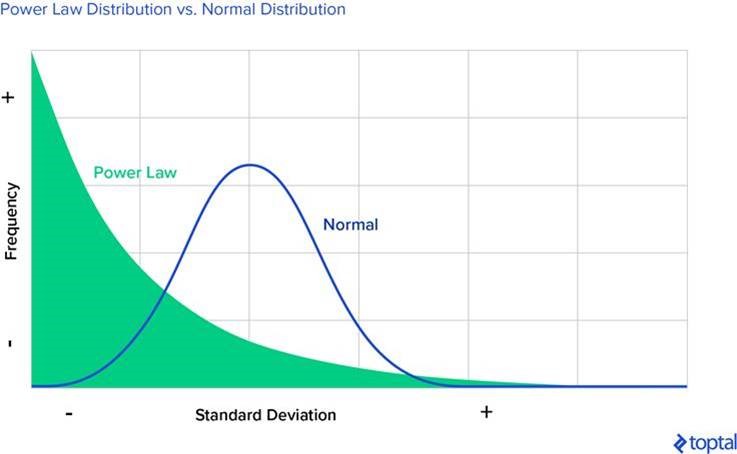
Startups in winner-take-most markets are not just in a home run business; they are in a grand slam business. Early-stage venture firms observe Power Law distributions in which over 90% of returns come from just 10% of invested capital. Over two-thirds of venture investments lose money according to a ten-year study by Correlation Ventures. Less than 1% of venture-backed startups achieve IPOs. Consolidation continues among public companies: just one of the 23 U.S. tech IPOs in 2019 accounted for 30% of the combined market value a year later among over 6000 venture-backed startups funded that year.
Figure 1: Power Law v. Normal Distributions
Virtuous Cycles and Vicious Circles in Winner-Take-Most Markets
Startups in winner-take-most markets experience virtuous cycles or vicious circles as markets mature. Startups that reach critical mass can achieve escape velocity by tapping virtuous cycles while subscale firms risk falling into a downward spiral. Escape velocity in astronomy refers to the speed – 25,020 miles per hour – required to exit the earth’s gravitational pull. Startups face their own gravitational pull as those that grow too slow get subsumed by incumbents or upstart competitors.
Companies at critical mass achieve escape velocity by tapping virtuous cycles – a positive self-reinforcing feedback loop in which each positive result reinforces and accentuates the next positive outcome. Virtuous cycles through the positive correlation among growth, market share, profitability, investment, product offerings and customer satisfaction. Rapid growth increases market share, which augments market power, which give firms leverage to increase profitability, which enables larger investments to improve products and expand services, which attracts more customers, which accelerates growth and restarts the next iteration of this positive cycle.
Vicious circles have similar structural dynamics running in the opposite direction. Slower revenue growth and declining market share increases customer acquisition costs and reduces margins, which lead to cost cutting, which reduces investment in product and service quality, which increases customer churn, which reduces revenue and triggers more cost cutting. Sears, Kmart and JCPenney were once leading retailers that demonstrated this pattern over extended periods once Walmart and Costco surpassed them.
Network effects and economies of scale are the primary forces that drive virtuous cycles in winner-take-most markets. Both increase operating leverage, which improves unit economics as firms grow and gain market share. Network effects increase the value of a product or service as new customers are added to social, communication or data networks. Economies of scale reduce incremental operating costs as new users are added. Together network effects and economies of scale increase returns with growth in winner-take-most markets, while with diminishing marginal returns encourage fragmentation in perfectly competitive markets. Accelerating growth and increased market share unleash powerful positive dynamics for market leaders in winner-take-most markets: they increase lifetime customer value by reducing customer acquisition costs, marginal operating costs and customer churn while increasing average revenue per user (ARPU) as firms offer a broader array of services.
The venture industry thrives in winner-take-most markets where virtuous cycles and increasing returns to scale prevail. Venture investment accelerates growth by funding upfront capital costs and early losses until startups reach critical mass with operating leverage to improve unit economics and become highly profitable.
Virtuous cycles are readily recognizable in retrospect yet harder to exploit as they unfold. What strategies and tactics enable startups to accelerate growth, attract venture investment and achieve escape velocity?
Turning the Flywheel
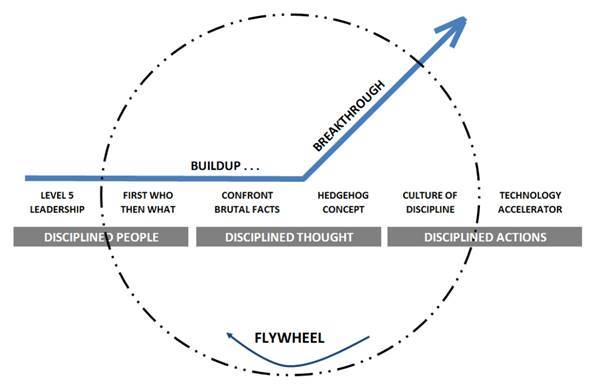
In his 2001 book Good to Great, Jim Collins introduced the flywheel as a metaphor to explain how companies build enduring businesses. Collins returned to this topic two decades later in Turning the Flywheel advocating for a carefully designed strategy and disciplined execution that align key aspects of the business to achieve escape velocity.
He described the flywheel process as follows: “In building a great company, there is no single defining action, no grand program, no one killer innovation, no solitary lucky break, no miracle moment. Rather, the process resembles relentlessly pushing a giant, heavy flywheel, turn upon turn, building momentum until a point of breakthrough, and beyond.”
A flywheel like the one shown in Figure 2 requires enormous effort to budge but less effort with each rotation as momentum builds. Flywheels build kinetic energy so that rotational force becomes self-sustaining and stopping it requires as much energy as starting it once had. The “moment of inertia” measures resistance and the amount of energy required to change rotational speed. Flywheels store kinetic energy well: the amount of energy stored in a flywheel is proportional to the square of its rotational speed, and the energy required to stop a flywheel equals the energy invested to achieve its initial velocity.
Figure 2: Flywheel as shown in the Russian Industrial Museum

Applied to business, the flywheel effect equates to a virtuous cycle achieved by a company when its key business elements align in an interlocking, mutually reinforcing set of business activities. The flywheel initially turns slowly as startups vie for attention amid the cacophony of the market and struggle to overcome early customer skepticism. Winning the first customer is the hardest, but each successive customer win gets easier as the company delights initial customers, earns complimentary references, builds brand recognition, perfects best practices, reduces costs, improves unit economics, and attracts added talent and capital to expand the business. Escape velocity is the business equivalent of the moment of inertia in physics.
Figure 3: Escape Velocity – Flywheel Buildup and Breakthrough in Turning the Flywheel
Collins further notes: “Once you fully grasp how to create flywheel momentum in your particular circumstance and apply that understanding with creativity and discipline, you get the power of strategic compounding. Each turn builds upon previous work as you make a series of good decisions, supremely well executed, that compound one upon another. This is how you build greatness.
“Never underestimate the power of a great flywheel, especially when it builds compounding momentum over a very long time. Once you get your flywheel right, you want to renew and extend that flywheel for years to decades – decision upon decision, action upon action, turn by turn – each loop adding to the cumulative effect. But to best accomplish this, you need to understand how _your specific flywheel turns.
“The flywheel, when properly conceived and executed, creates both continuity and change. On the one hand, you need to stay with a flywheel long enough to get its full compounding effect. On the other hand, to keep the flywheel spinning, you need to continually renew and improve each and every component.”
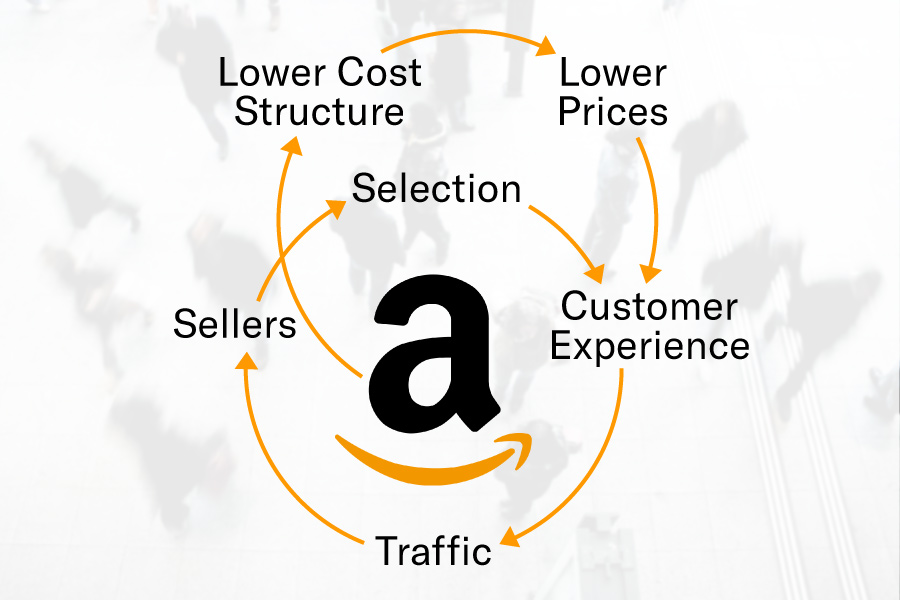
Amazon adopted the flywheel as a core part of its business strategy. In The Everything Store, Brad Stone described the Amazon flywheel as follows: “Bezos and his lieutenants sketched their own virtuous cycle, which they believed powered their business. It went something like this: Lower prices led to more customer visits. More customers increased the volume of sales and attracted more commission-paying third-party sellers to the site. That allowed Amazon to get more out of fixed costs like the fulfillment centers and the servers needed to run the website. This greater efficiency then enabled it to lower prices further. Feed any part of this flywheel, they reasoned, and it should accelerate the loop.”
Figure 4: Amazon Flywheel
Flywheel Model Design for Startups
The flywheel model is customized for each business and evolves as companies grow and market conditions shift. Amazon has expanded its flywheel model with the additions of AWS and Prime but the core components of the model remain. Artificial intelligence will disrupt many businesses, yet three elements remain fundamental to a well-designed flywheel model:
- Key Success Factors: The core components of a flywheel model represent the value proposition for the business and key success factors for the market. Among many factors that vie for founder attention, the flywheel model distills the business to its essence with not more than six core components. Flywheels should be both comprehensive and sparse with three to five flywheel elements as the norm. Founders may test flywheel validity by considering the following question: Do we have the right to win if we deliver on each element as anticipated?
- Strategic Alignment: A compelling flywheel model is sequential and interconnected. Momentum builds when delivering on one core component of the model inexorably enhances the capacity to deliver on the next factor in the model. Product quality and pricing drive demand. Demand premeditates supply and customer service. The model is circular as growth attracts investments, which enables further growth. The flywheel model distinguishes between core and non-core functions and should connect and align all core business activity. Strategic alignment helps ensure that all business activity pushes in the same direction.
- Acceleration through Disciplined Execution: Starting a flywheel requires enormous initial energy and moves slowly, almost imperceptibly at first. But the ratio of flywheel acceleration to energy required should improve with each spin. Progress may be measured by faster sales and implementation cycles or inventory turns. Faster cycles accelerate growth and product development while improving agility in response to customer demands and market changes.
As you designed a flywheel model for your business, let’s consider two factors that influence flywheel implementation: (1) startup organization and (2) timing of resource commitments.
Flywheel Model: Organizational Considerations
Bain studied over 3,500 companies for five years and found that only 9% of companies grow sustainably. Successful founders start with an insurgent idea but face common scaling challenges: attracting talent, customers and investors to fuel growth; aligning efforts as businesses grow and become more complex; and maintaining customer loyalty as supply chains expand.
Bain identified three stages and distinct skills that startups must develop as a business grows: (1) a “disruptive community” that drives innovation; (2) a “scaling community” that integrates best practices across the company; and (3) an “execution community” that streamlines operations as business scales.
Bain’s Win/Scale flywheel model incorporates both continuity and change needed to maintain an Insurgent Mindset while scaling with strong execution. Amazon strikes a similar balance by repeating its Day One Mentality in its annual shareholder letter as business continues to expand.
Figure 5: Bain Win/Scale Flywheel Model
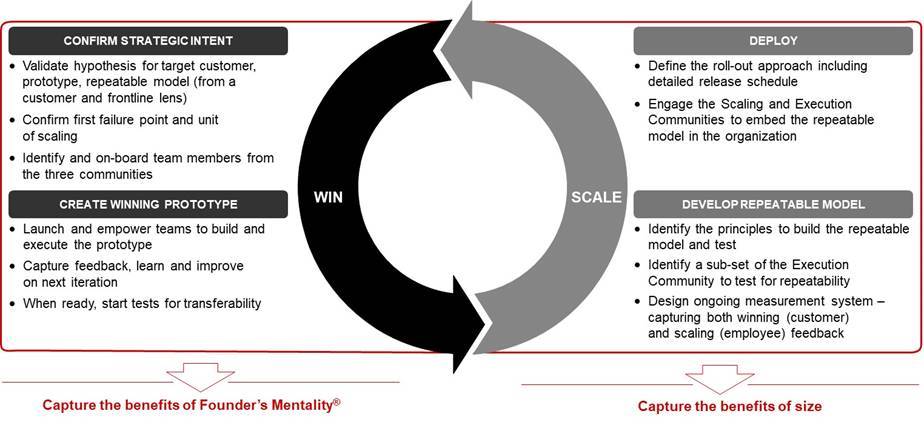
Source: Zook & Allen, The Founders Mentality: How to Overcome the Predictable Crises of Growth
The Flywheel and Product Market Fit: Timing of Resource Requirements
Both the Lean Startup and flywheel models emphasize the need for speed and agility prior to achieving product market fit. The energy required to overcome the moment of inertia is geometrically proportional to the weight of a flywheel. While a sports car goes from 0 to 60 miles per hour in under four seconds, a tractor-trailer truck may take a minute to reach the same speed.
The Lean Startup model incorporates agility with minimum viable products and agile development practices prior to validating product market fit. In The Four Steps to the Epiphany: Successful Strategies for Products that Win, Steve Blank observed, “The number one problem I’ve seen for startups, is they don’t actually have product/market fit, when they think they do… Startups need 2-3 times longer to validate their market than most founders expect. This underestimation creates the pressure to scale prematurely… In our dataset we found that 70% of startups scaled prematurely along some dimension. While this number seemed high, this may go a long way towards explaining the 90% failure rate of startups.”
When Sam Altman was at Y Combinator, he similarly observed, “In general, hiring before you get product market fit slows you down, and hiring after you get product market fit speeds you up. Until you get product market fit, you want to a) live as long as possible and b) iterate as quickly as possible.”
In sailing, they say that races are won at night and in still wind. Turning the flywheel may be painstaking work at the beginning and progress may seem frustratingly slow, especially when facing industry headwinds. But as Jim Collins noted in Upward Bound: Nine Original Accounts of How Business Leaders Reached Their Summits, more companies succumb mentally before they expire physically.
The flywheel model reminds us that slow, hard-won progress at the outset leads to larger future wins when businesses focus, align and execute on the core components of their value proposition.
Related Concepts
High potential startups need to Manage the Clock to execute within the Window of Opportunity – the timeframe during which a market winner is determined. Markets speed up when customers select a Dominant Design and startups achieve Product Market Fit. Winner Take Most Markets, especially those subject to Economies of Scale and Increasing Returns to Scale, increase rewards for winning markets and will accelerate efforts to achieve Critical Mass. Market dynamics influence First Mover Advantage versus adopting a Fast Follower strategy.
Financial factors also impact appropriate pacing. Sustainable Growth Rate determines the pace at which a company can grow without raising external funding. Capital availability will influence potential pacing, which depends on where a product is on the Gartner Hype Cycle. Capital Intensity determines funding requirements to scale a business. Raising equity to accelerate growth dilutes shareholders and impacts Return on Investment while raising debt increasing Leverage, which increases business risk and requires a higher Margin of Safety.
Lean Startups can reduce Capital Intensity by Rapid Prototyping with a Minimum Viable Product and adjusting quickly based on customer feedback.