
Art & Science of Attracting Talent to Accelerate Startup Growth

Paul Asel
Founding Partner at NGP Capital·
Who is your number one problem. Not what. Talent is the key to startup success. Attracting talent is an ongoing, three-phase process from prospecting to onboarding.
Idea in Brief
- Most executive placements are mis-hires costing firms up to ten times compensation costs.
- Prospecting for talent is a continuous process that uncovers hidden gems and helps assess cultural fit and performance capacity before formal searches start.
- Formal searches improve yields with a Who Scorecard that aligns views on desired traits in advance and measuring candidates accordingly.
- Onboarding completes the hiring process by integrating recruits into the company culture and ensuring new executives secure early wins.
Who is your number one problem. Not what.
Founder’s dilemmas start, and too often end, with the founding team. Founder Market Fit precedes Product Market Fit for early-stage investors.
A successful startup must balance many competing demands. In the roulette of the urgent versus the important, “what” commands urgent attention while “who” lurks in background stealth mode surfacing, often existentially, at the most inopportune times.
In Thinking, Fast and Slow, Daniel Kahneman distinguishes between instinctive decisions and more complex, critical calls that command careful consideration. “What” is typically a thinking fast question while “who” requires thinking slow. In the din of daily events, founders often conflate these questions and answer them at the same pace.
The invoice for who mistakes comes later, but the price paid is often much higher. About two-thirds of executive placements are ultimately deemed mis-hires. Executive mis-hires may cost firms up to ten times compensation costs once factors such as lost time, foregone revenue and organizational disruption are considered. Investing up front to improve yield on executive recruitment pays healthy dividends by accelerating growth while reinforcing company culture and confidence in leadership of the firm.
Prospecting for Talent: Building A Talent Pipeline
As with customer sales, prospecting for talent is a continuous process. Enterprise sales are lumpy and backend loaded at the end of the quarter or year, yet sales cycles are long requiring sustained attention. Similarly, companies can consistently fulfill sporadic hiring needs when they have developed a deep pipeline of talent in advance. Otherwise, companies that start a search only when a need arises are rolling dice late in the process.
A talent pipeline is vital in thin markets, which is the case both for remote locations and specialized skillsets. Intercorp Perú, for example, has for decades maintained a database of all U.S. college grads from its country who work in U.S. corporations. The company tracks career progress of some prospects for many years before contacting them regarding a potential job opportunity. Though a laborious process at the time, developing a deep talent pipeline was a key differentiator for Intercorp enabling them to expand into financial services, retail, education and health services. Intercorp now employs over 107,000 people and is one of the largest firms in South America.
Developing a talent pipeline today has never been easier using AI agents that continuously search ample online personal data. Ubiquity should not breed complacency, however, as the stakes for attracting and retaining top talent are higher than ever. Finding hidden gems becomes more important when firms have readier access to common talent pools.
Candidates appear at their best in interviews when preening, prepared and on good behavior. The gap can yawn widely between interviewees and employees enmeshed in the din of daily events. Extended, informal engagement may be a better forum to assess cultural fit, professional skills and performance capacity before the formal recruitment process.
Executive Searches: The Who Scorecard
The formal recruitment process starts with a job requisition specifying key responsibilities and qualifications desired in a successful candidate.
Leading management advisory firm ghSmart pioneered the use of a scorecard to translate the job requisition into a set of measurable outcomes a candidate must achieve in order to be successful. Having used scorecards for dozens of executive hires as an investor, board director and company leader, I have found that time invested in advance to coordinate views makes the search more efficient and effective once the process begins.
Following is a sample scorecard for a CEO of an early-stage technology firm. We discuss below the four key components of the scorecard: job qualifications, weights, rating scale and comments.
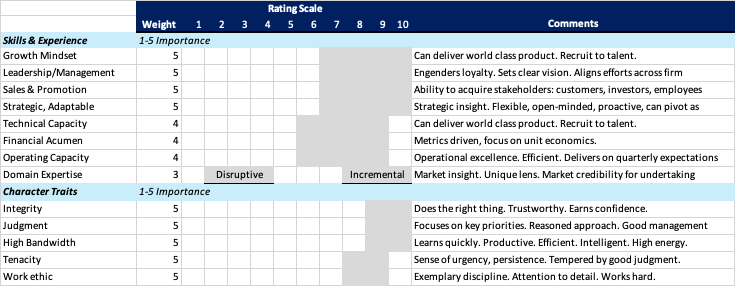
Job qualifications may be divided into two categories: skills and experience expected for this role and character traits that assess culture fit. Weights reflect the relative importance of each qualification indicating essential criteria versus nice-to-have traits.
The rating scale ranging from 1-10 indicates the desired range for qualified candidates. Any score outside the gray area signals a basis to disqualify a candidate. Higher scores are better for most, but not all, traits. Tenacity is highly desirable, for example, but unbending persistence and unrelenting urgency impair judgment and often produces poorer outcomes.
Required skills vary depending on the nature of the job. Promotional skills are essential in sales but undesirable in finance. Domain experience is essential for incremental innovation, but an outsider’s perspective is preferred for disruptive opportunities. Technical capacity is a prerequisite for deep tech innovation while strategic insight is required for business model innovation.
Comments serve two purposes. Authors of the scorecard template may provide detail on desired skills and guidance on how to score candidates, while evaluators explain the basis for their rating of each candidate. Detailed commentary helps coalesce views on selection criteria at the outset and elicit different perspectives from interviewers during the search process.
Interviewing and evaluating candidates is a time intensive process, so involvement should include those who materially enhance the search process and no more. Both those with insights that improve the search decision and whose support is needed once a candidate is hired should be included. Executive searches typically include company executives plus selected Board Directors and subject matter experts.
Executive searches often take 3-6 months, so allocate enough time to permit a full process. Search processes involve multiple rounds of increasingly intensive interviews and reference checks. They may also involve case study assignments and participation in selected company meetings. Present two or three finalists for review by the selection committee to show a range of qualified candidates and ensure flexibility if a candidate drops out in the final stages.
Onboarding Executive Talent: Forming, Storming, Norming, Performing
Onboarding is vital for successful placements and for organizational changes required with an expanded executive team. The first ninety days for any executive addition is unsettling both for the company and person. Reputations may be won or lost during this formative period. Transitions are eased by treading lightly initially and identifying low hanging fruit where the new executive can secure early wins. The firm and executive recruits share an interest in enabling a fast start and building goodwill for tougher challenges that surely lie ahead.
Founders should anticipate that recruiting a new executive involves regression before progression. What Bruce Tuckman observed in the 1960s remains true today. Teams progress through four stages of development: forming, storming, norming and performing.
Parents familiar with the ‘terrible twos’ in childhood development observe similar traits in team development: an unsettled period prevails before norms are established enabling teams to perform well. Anticipating the terrible twos in childhood development helps parents prepare and manage through this stormy period.
Executive teams experience their ‘terrible twos’ when onboarding a new executive. Established norms are altered when responsibilities are reallocated and new executives with different backgrounds, expertise and perspectives are added to the intimate weekly mix of meetings. Some storming is normal before an expanded executive team returns to performing.
The First 90 Days is a useful guide for new leaders at all levels as well as the firms who recruit them. The firm can ease the transition by ensuring that new executives are adequately informed about company culture, strategy and processes during onboarding. A handbook summarizing organizational tenets is a good onboarding guide for new recruits and a useful resource for current employees to monitor how the company is evolving.
New executives should tread lightly initially and listen before acting. Many new leaders instinctively grab the steering wheel and throw the prior regime under the bus. Seizing immediate control may be needed in crises with short runways. Unless the Board has specifically mandated this approach, new leaders should avoid this temptation. Instead, in the hundreds of executive transitions I have observed over the past four decades, new leaders who start with a ‘listening tour’ with all reports and colleagues perform better than those who hit the ground with wheels spinning.
Leaders who start with a listening tour often preface the agenda with up to five questions to consider in advance. Questions that frequently appear on the list include: (1) their role and what they are best at; (2) what they like best about the firm and want to preserve; (3) what the business needs to succeed and would most like to change; (4) what has prevented this change previously and how the change could best be conducted; and (5) how they can help.
- - -
The central task of an entrepreneur is to acquire stakeholders: employees, investors, partners and customers. Talent is the foundation on which startups are built and other stakeholders are acquired.
Attracting, nurturing and retaining talent is a continuous process. We have discussed three phases of attracting new talent: developing a talent pipeline; talent evaluation using the Who Scorecard; and onboarding to ease transition for new recruits.
Acquiring stakeholders is often a prolonged, foggy process. Recruiting talent, raising funding, soliciting partners and selling customers are marathons, not sprints. Attracting talent is potentially the most fulfilling of these efforts as great hires fuel business growth and form relationships that may extend well beyond the life of the firm.
May you achieve all your summits!
Related Concepts:
Founder Fit is the most important factor for startup success. Founder Fit measures founder traits relative to market requirements, while cultural fit measures executive traits relative to company culture.
For Further Reading:
- Noam Wasserman, The Founder’s Dilemmas. Reinforces that talent, compatibility and company culture are key success factors for any startup.
- Geoff and Randy Smart, Who: Solve your #1 Problem. A go to resource on sourcing talent, this book provides an in-depth view on how to integrate scorecards and conduct interviews to improve yields on executive searches.
- Michael Watkins, The First 90 Days. One of the first tasks for any incoming executive is assessing, attracting and aligning talent.