
Crossing the Chasm: Marketing Road Map to Scale Startups

Paul Asel
Founding Partner at NGP Capital·
Great marketing often outflanks superior technology. Crossing the Chasm offers a marketing road map to win customers across the technology adoption lifecycle.
Idea in Brief
- A chasm divides buying patterns of early adopters and mainstream customers. Startups must adjust sales strategy to scale beyond early adopters.
- Savvy startups pick one narrow market segment as a beachhead, win it completely, then use referenceable customers as a launchpad for broader adoption.
- The Technology Adoption Cycle includes five distinct customer profiles requiring four distinct phases of product development, sales and marketing. Airbnb illustrates successful strategies for each phase.
Successful startups light bonfires with a match. Matches are fragile, have short fuses, and light small flames that last only a few seconds. Wind and rain snuff out lit matches quickly. Thick bark render logs and trees impervious to matches. But a match dropped into dry kindling spreads quickly first to underbrush, then to saplings and soon a torrent of flames consumes vast forests that seemed impregnable moments earlier.
As with bonfires, successful startups scale not by attacking incumbents directly or pursuing mass markets immediately. Instead, they iterate quickly with early adopters, establish beachheads and secure leadership in niche markets, garner marquee customers as sterling references, then cross the chasm with mainstream customers, and leverage momentum to scale in mass markets. Airbnb is one of many recent successes that illustrate this progression.
Airbnb: Securing a Beachhead before Scaling Globally
Airbnb has championed homestays as an alternative to hotels with over 9 million listings that have hosted over 2.5 billion guests in 220 countries. The market opportunity championed by Airbnb seems obvious today, yet no one foresaw its success in those early days, not even the founders. They hoped to reach $2 million in revenues in the first three years, far from the $12 billion achieved two decades later.
Convincing homeowners to open their houses to strangers was a formidable task. Airbnb almost failed many times in the first two years of operation. After a promising early start, the website was dormant for much of the first year with rentals rarely exceeding $200 per week. Venture investors spurned the idea. Yet the founders were like cockroaches: they were unkillable and scrappy. Describing themselves ‘cereal entrepreneurs’, they designed cereal boxes featuring presidential candidates to get media coverage and fund their business during the first year. The cereal boxes, not their idea, won them entrance to Y Combinator as Paul Graham liked their ingenuity despite disdaining the homestay marketplace concept.
Despite Graham’s initial skepticism, Y Combinator helped the founders bring Airbnb to fruition. Understanding that it is better to have 100 users that love you than 1000 that like you, they did things initially that could not scale to establish a beachhead in New York City. They traveled cross country to visit the homes of all Airbnb hosts. They hired specialists to photograph and write descriptions for their New York listings. They convinced hosts to offer discount pricing initially then raise prices as demand increased.
Success in New York City enabled Airbnb to cross the chasm and grow in other cities and countries. Guests who enjoyed their stay in America’s leading city started hosting guests in their hometowns mimicking the quality of service, photos and descriptions of their New York City hosts. Crowdsourced ratings improved trust among hosts and guests offering a reliable alternative to hotels for business travel and tourists. Airbnb became a preferred destination site when homestay listings became ubiquitous offering housing in places that hotels could not serve.
The Chasm: From Early Adopters to Mainstream Customers
Crossing the Chasm is a classic that has guided entrepreneurs in startup sales and marketing strategy for nearly four decades. Author Geoffrey Moore and I have served on startup boards together for many years where his beachhead and chasm method has been invaluable helping entrepreneurs identify market niches with products that scaled to broader markets.
The central insight of Crossing the Chasm is that technology adoption is discontinuous. A “chasm” exists between buying patterns of early adopters and early majority customers requiring different sales strategies for market entry and scaling the business. Early adopters are visionaries with the insight to match emerging technology to strategic opportunity. Early adopters are undeterred by novel, incomplete products in their quest for competitive advantage. Early majority customers are risk averse pragmatists who delay purchase decisions until peer references affirm the product as complete, proven and reliable. Figure 1 illustrates this chasm in the technology adoption cycle.
Figure 1: Technology Adoption Lifecycle and Chasm between Early and Mainstream Adopters
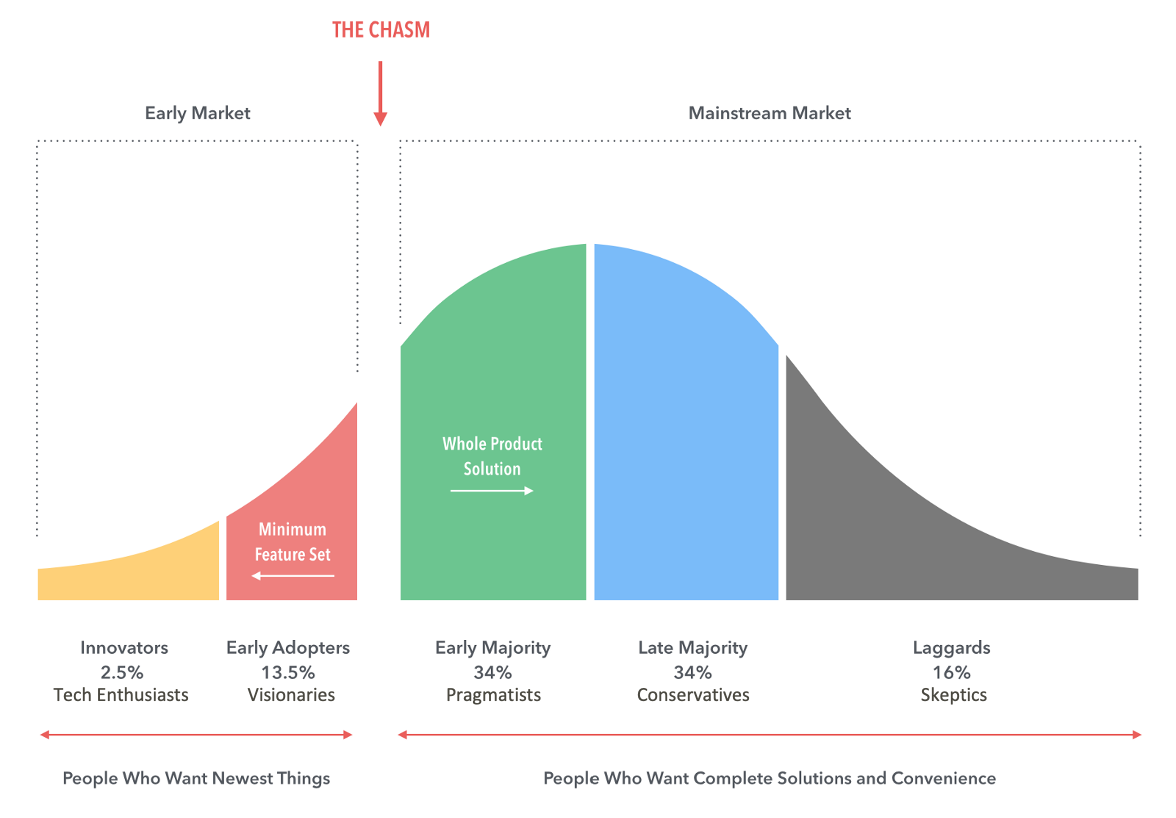
Startup success with early adopters often obscures mainstream customers requirements. Early success may obstruct scalability unless startups adapt sales and marketing strategies to cross the chasm. Moore’s prescription is to pick one narrow market segment as a beachhead, win it completely, then use it as a launchpad for broader adoption.
Moore identifies four startup stages for product development, sales and marketing. Startups first test demand and user requirements with innovators, then win a niche market by developing the product with early adopters, then cross the chasm and scale the business with early majority customers, then expand with an installed base of customers.
- Alpha & Beta Stage: Adapting the Product with Innovators
The Lean Startup tests a Minimum Viable Product with innovators and adapts the solution based on their feedback. Tough not paying customers, these tech enthusiasts are savvy users with intimate knowledge of your target market and existing technology relevant to your target audience. They can guide the product road map, position the product among competing solutions, suggest alternative use cases, and introduce early adopters for your beachhead strategy.
Airbnb founders first tested their solution renting an air mattress in their own apartment during the popular Dreamforce conference that overwhelmed hotel capacity in San Francisco. The website received many more requests than they could handle validating the concept.
- Beachhead Strategy: Light the Fire with Kindling
A beachhead is a market segment that is small enough to lead, big enough to matter, and aligned with a startup’s mission and core product. The beachhead should focus on one geography, one market segment and one use case where the pain is largest and economic value of your solution is highest.
Airbnb focused initially on business travelers attending large conferences. After validating rental demand in San Francisco at Dreamforce, Airbnb tested willingness to host homestays by securing places for nine attendees at the South by Southwest technology conference in Austin, Texas. Attendees were technically savvy, desperate for accommodation, open to novel solutions, and price insensitive relative to leisure travelers. Hosts were young and tech savvy eager to earn extra cash and meet peers attending the conference. The kindling for a homestay marketplace was lit.
Niche markets overlooked and left unguarded by incumbents are good candidates for beachheads. Upstarts can achieve market leadership in underserved niche markets, often without attracting attention from incumbents and usually without inciting competitive retaliation. Market leadership paves a path to cross the chasm with pragmatic buyers that require proven suppliers. The fully booked hotels in Austin did not miss the nine attendees who used Airbnb despite fawning media coverage for this new service.
A good beachhead requires both visionaries and referenceable customers as early adopters. Visionaries help refine and extend the product into a complete solution. Reference customers provide credibility needed to cross the chasm and sell to mainstream customers.
Visionaries are kindling (a term used by Moore) for startup customer engagement. They are eager early adopters whose pain is poignant. They are motivated to play with the product and provide feedback. They are price insensitive but are demanding and hard to please. They have insight to translate emerging technology into strategic opportunity. Seeking competitive advantage, visionaries tolerate incomplete solutions but look for potential breakthrough products, not incremental improvement. Airbnb realized through feedback from the South by Southwest conference that payment concerns blocked broader adoption. Airbnb established online payment in advance so hosts could focus on service rather than collecting payments.
Reference customers are industry leaders that other potential customers will follow. They are pragmatists, not visionaries, who require complete, reliable solutions. They typically wait until visionaries validate product value. Reference customers have longer sales cycles, yet they share the pain of early adopters and will work closely with startups to develop a compelling solution – often customized for their distinct requirements.
Large, referenceable customers can make or break a startup. Product customization is both a risk and opportunity for startups. Startups at the beachhead stage are still project based and have not yet fully developed their product. Working with reference customers can help startups develop the whole product with feedback from an established industry leader. Yet customized solutions can turn startups into service firms. Long development cycles with market leaders drain resources and divert founder attention that may cause startups to miss the window of opportunity. Startups must be willing to develop a solution that delights reference customers while resisting highly customized, overengineered solutions unfit for broader use. Development partners may help integrate addons for key customers.
Successful startups do the delicate dance of engaging market leaders and tolerating some customization while securing a reference customer who champions startup efforts to cross the chasm. The imprimatur from brand name market leaders endows a halo effect on promising, but still unproven startups. Once satisfied, incumbents affirm market leadership by convincing others to follow their initiatives. Reference customers become advocates for product when forearmed with a customized solution that reinforces their leadership as other customers adopt the product.
When a startup wins 15-20% share in its target niche, the market starts to organize around the solution. Sales switch from push to pull as startups begin to harvest inbound interest and cross the chasm to mainstream markets. The reference customers for Airbnb were a cluster of young New York City residents eager to defray the high cost of monthly apartment rentals who provided user feedback and accepted guidance to increase rentals. They helped build out and refine Airbnb’s offering that they could then offer to users in other cities and countries.
- Crossing the Chasm: Fanning Flames to Create a Bonfire
Crossing the chasm is consistent and concurrent with achieving product market fit, a recent term coined after the book was published. Customers at this stage have designated budget for the product, so sales and marketing shifts from promoting product benefits to positioning your product as preferred over competing solutions. Startups sign distribution partners and raise funding to accelerate growth as market dynamics shift to scaling the business, winning market share and securing market leadership.
Crossing the chasm also enables startups to expand from beachhead niche markets into adjacent markets that increase the Total Available Market for their solution. Product extensions that cover broader use cases facilitate this expansion.
Airbnb’s initial focus on overflow supply during popular conferences was episodic. Airbnb needed a business model that provided a steady supply of customers to homeowners. Airbnb also needed broader listings offering better accommodations to attract high volume business and leisure travelers. Airbnb cracked the code by disrupting the incumbent hotel market rather than supplementing it.
Hotels have a limited footprint concentrated in city central business districts since dedicated buildings and staff for overnight stays are capital intensive with high operating costs. By tapping into a preexisting inventory of rooms in houses, Airbnb offered a more efficient business model that enabled expanded coverage for convenient stays throughout cities and in towns that lacked hotels. A marketplace model for homestays unlocked a virtuous cycle: a larger supply of listings attracted more consistent rentals from travelers, which increased revenue opportunity, which encouraged homeowners to invest to offer better rooms, which attracted high end customers willing to spend more on homestays, which encouraged homeowners to offer better services to improve the user experience.
- Late Majority: Land and Expand
As technology adoption moves into the second half of the potential market, new customers are conservative desiring proven and reliable full-service models. While opportunity remains by converting these new customers, market leaders will either win these customers by default in winner take most markets else competition for new customers will be intense.
Much of the remaining profit potential will come from existing rather than new customers. Focus shifts to a land and expand model where selling and product development seeks to capture a larger share of customer wallets. Attention turns to cross selling ancillary services or upsell premium solutions to existing customers. Financial metrics focus on net dollar retention, which measures revenue growth with existing customers less revenue lost from customer churn. While net dollar retention varies with industry stage and nature of the business, the ratio should always exceed 1.00 and occasionally exceeds 1.25 among high growth companies.
Airbnb has expanded ancillary services to offer turnkey solutions for homeowners and renters. New services include rental insurance and cleaning for homeowners and travel guides and promotions for renters. Revenue growth has risen both through increases in Nights Booked and the Average Daily Rate, which measures rental rates plus these added services.
Few people recall today that Airbnb was once a struggling business with episodic revenue operating in a niche market for overflow room rentals when cities hosted popular conferences. Crossing the chasm has transformed Airbnb into an asset-light, highly profitable business disrupting a capital-intensive traditional hotel industry. Once scorned by the venture industry, Airbnb is now a Wall Street darling dominating a large, lucrative business with high barriers to entry.
As Airbnb illustrates, crossing the chasm can be transformative for many startups. Most successful disruptive startups have difficulty raising initial funding because the ultimate opportunity differs radically from that which is visible at the outset. Investors miss the forest and see only the kindling. Few appreciate how the flickering match of a disruptive startup can transform itself into a bonfire that consumes seemingly impregnable forests inhabited by incumbents.
May your match withstand the windy tempests that test all startups, fan the kindling flames and leap the chasm to find fertile forests to ignite a bonfire.
Related Concepts
Crossing the Chasm seeks to accelerate the Startup Flywheel to reach critical mass and achieve Escape Velocity and win market leadership within the Window of Opportunity.
Lean Startup methods including Minimum Viable Product, Rapid Prototyping and A/B testing align closely with the first stage of the Technology Adoption Lifecycle. Crossing the Chasm emphasizes the Value Proposition as the sales and marketing equivalent of product oriented concepts such as Product Market Fit and Dominant Design in the third stage of the Technology Adoption Lifecycle. Product Led Growth emphasizes Product Differentiation, user friendly interfaces and ease of adoption as an alternative to a sales and marketing led approach typified in Crossing the Chasm.
The Technology Adoption Lifecycle is distinct from but from but consistent with the Industry Lifecycle, which measures industry growth and competitive dynamics. In both lifecycle models, Served Available Market approaches Total Available Market as the industry and adoption mature. A transaction-based revenue model will align these two lifecycles more closely than a subscription revenue model, which extends industry lifecycle revenue horizons.