Unknown Unknowns: Navigating through the Fog of Disruptive Innovation

Paul Asel
Founding Partner at NGP Capital·
Rapid iteration and agile adaption accelerate progress when navigating in rapidly changing, uncertain environments. We discuss three strategies to uncover hidden opportunity in an uncertain world.
Idea in Brief
- There are no maps nor linear paths to IPO for original companies. The way forward for disruptive innovators is unmarked, overgrown, boulder strewn, beset by hidden crevasses and shrouded in fog.
- The Rumsfeld Matrix and Johari Window introduce three classes of unknowns, which involve varying processes of invention, recognition and discovery to uncover hidden opportunity and mitigate risk.
- Methods to navigate efficiently through startup fog include first principle thinking, a serendipity mindset, hypothesis testing with carefully designed experiments, and gradient descent optimization.
A small plane crashes on an Alaskan glacier. The pilot and his passengers miraculously survive. What should they do next – await rescue at the crash site or hike toward safety over treacherous territory in stormy conditions? Initially contrived as a thought experiment, this scenario has occurred at least twice recently: in Alaska in 2010 and Canada in 2016. Survival under these conditions is rare, yet in these fortunate cases, passengers emerged unscathed using different strategies. Two survivors hiked to safety in Canada, and passengers were rescued at the crash site in Alaska.
Standard narratives describe great leaders as riding unscathed above din of daily events. Yet a closer review indicates that it is not the absence of career cliffs and foggy periods that distinguish great leaders but rather how they navigated through those crucible moments. In What it Takes, Richard Ben Cramer found that successful U.S. presidential candidates forged their core principles through life altering crucibles that annealed them to glare of public scrutiny.
Startup founders face different challenges than public officials, yet the pressure is no less intense. In the fog of war, paradigm shifting startups pursue nascent opportunities in fast changing, uncertain and intensely competitive environments. As startup planes careen toward the glacier with short runways as cash dwindles, founders must decide whether to pivot or persevere under the glare of investor expectations.
Unknown Unknowns: Innovating in Invisible Markets
The Five Forces Model suggests that industry structure is knowable in advance. Bargaining power of suppliers and customers, barriers to entry and capital intensity preordain ultimate industry structure. Bargaining power tilts the landscape toward larger firms with access to prized resources. Capital-intensive businesses have fewer competitors than those with low barriers to entry. Personal utility apps grow more linearly than marketplaces or social apps with strong network effects. Understanding market structure enables companies to anticipate competitive dynamics and optimize strategy at the outset.
Regardless of industry structure, many vital variables remain indeterminant. Market timing varies with rates of customer adoption, technology advances and regulatory approvals. Product requirements vary across different market segments, and dominant design emerges through a process of discovery. Funding fluctuates in cyclical markets. Competitive dynamics may shift dramatically depending on whether incumbents focus on or ignore startups adjacent to their sphere of interest.
During the Iraq War in 2002, U.S. Defense Secretary Donald Rumsfeld divided knowledge into four categories of knowns and unknowns. The Rumsfeld Matrix may be used to map degrees of uncertainty, risk and opportunity. Known knowns involve low market risk but invite intense competitive as opportunities in this quadrant are visible to all.
Unknowns involve three different types of knowledge gaps: information is (1) knowable but beyond our current knowledge frontier; (2) unknowable in advance of undertaking an endeavor; or (3) known but overlooked and dismissed. The three quadrants involve unknowns entail latent opportunity and varying degrees of risk. Strategies to tap opportunity and mitigate risks differ for each quadrant. Unknowns in each quadrant are unearthed through investigative processes of recognition, invention and discovery.
Figure 1: Rumsfeld Matrix – Knowledge, Risk and Opportunity
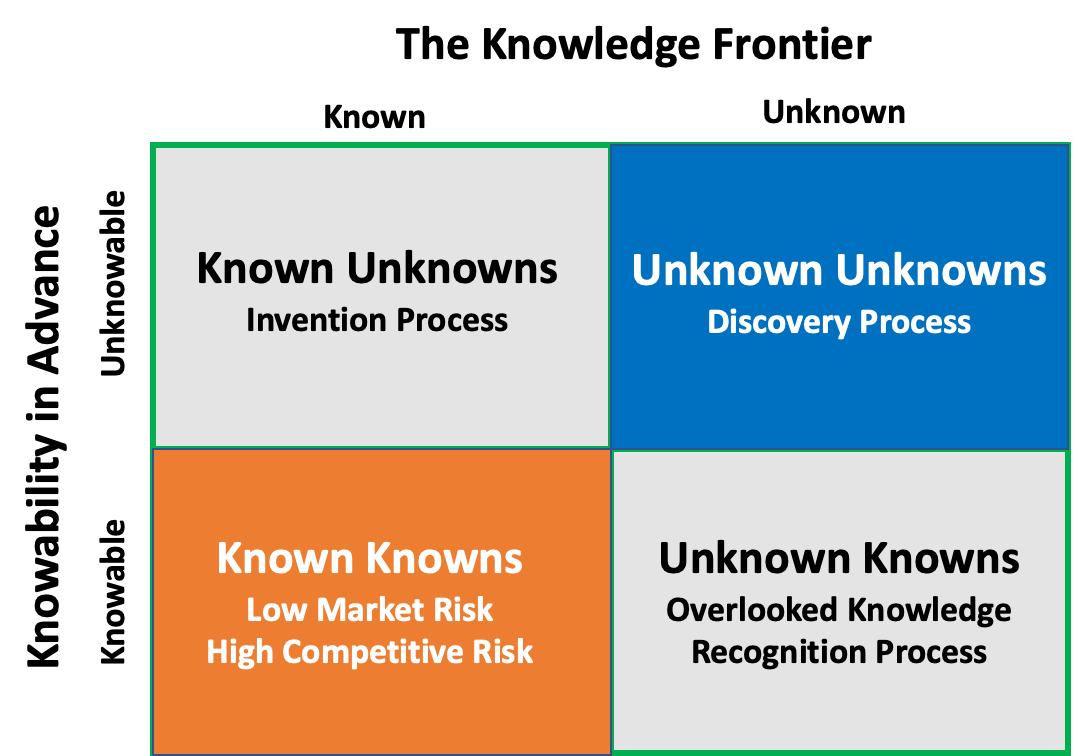
Unknown knowns involve knowledge that is subconscious, overlooked or dismissed as irrelevant. Unknown knowns are latent opportunities uncovered through Kirznerian innovation – a recognition process for arbitrage opportunities that alerts entrepreneurs who seize and exploit them.
Known unknowns involve factors we know exist but do not fully understand. Known unknowns are latent opportunities uncovered by bridging knowledge gaps through research and invention. Schumpeterian innovation derives primarily from this quadrant.
Unknown unknowns involve factors that we are not aware of and cannot predict. They are a source of significant uncertainty but may also unearth significant opportunity for those who uncover them.
Market Knowledge & Self-Knowledge: Insights and Blind Spots
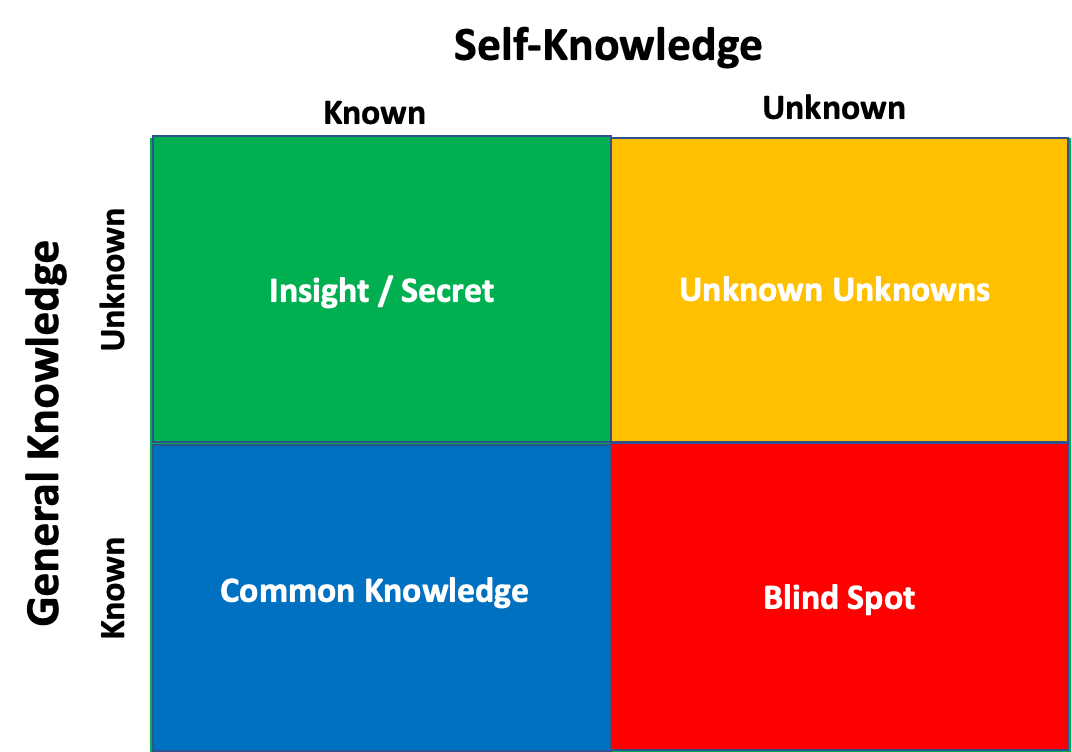
A second knowledge distinction is the difference between generally available knowledge and information available to decision makers. As Figure 2 illustrates, common knowledge is of little interest to innovators while secrets and insight create startup opportunity and blind spots introduce risk for entrepreneurs.
Blind spots involve lack of awareness of knowable information. Industry experience, functional expertise and access to expert advisors mitigate blind spots. But expertise also creates blind spots when adherence to industry practices inure insiders to new disruptive opportunities. Eliminating blind spots requires one to remain alert to new opportunities while leveraging expertise accrued through experience. Amazon has sought to strike this balance by promoting a Day One mentality, which it includes annually in its letter for shareholders.
Insights arise from personal knowledge that is not widely appreciated by the market. Investors recognize that second order thinking is needed to outperform the market as correct contrarian positions can yield outsized returns while consensus decisions deliver average outcomes. Venture investors ask entrepreneurs the contrarian question: What important truth do very few people agree with you on?
Figure 2: Johari Window – Insights, Blind Spots, Unknown Unknowns
Strategies to Navigate through the Fog of Disruptive Innovation
Zero to One startups pursue huge markets that do not yet exist. Yet there are no maps nor linear paths to IPO for original companies. The trail for incremental innovation is well-trodden, but the way forward for disruptive innovators is unmarked, overgrown, boulder strewn, beset by hidden crevasses and shrouded in fog. Disruptive startups pursue nascent, invisible markets and must adapt to change in fast-moving, uncertain environments.
While venture investors seek disruptive innovation, they often fail to appreciate opportunity when they see it. At least half of disruptive startups that reach IPO had difficulty raising initial funding. Amazon took over a year to raise its first round. Squarespace bootstrapped the business for seven years before receiving a first round of funding. Y Combinator rejected PagerDuty founder Alex Solomon four times before admitting him. Peloton CEO John Foley described raising initial funding as ‘bone crushing’ despite his pedigree as a proven entrepreneur.
The challenges of creating a new order of things are not new. As Machiavelli observed in the fifteen century: “There is nothing more difficult to plan, more doubtful of success, nor more dangerous to manage than the creation of a new order of things … Whenever his enemies have the ability to attack the innovator they do so with the passion of partisans, while others defend him sluggishly, so that the innovator and his party alike are vulnerable.”
The optimal strategy for navigating through the fog of disruptive innovation varies depending on the nature of the unknowns.
- Known Unknowns - First Principles Thinking aids the inventive process for Known Unknowns. Elon Musk conceived of several successful startups through first principles thinking, including SpaceX, Tesla, Zip2, Solar City and Neuralink. First principles thinking decomposes complex problems into basic, irreducible elements and reconstructs solutions from foundational theories rather than relying on analogy or conventional wisdom. First principles thinking enables one to simplify complex problems by focusing on and resolving discrete elements then building a solution from its constituent parts. First principles thinking also enables innovators to accelerate progress by subcontracting aspects of the problem to specialists.
- Unknown Knowns: Exploiting overlooked opportunity requires two distinct but related capabilities: the alertness to identify and initiative to pursue hidden opportunities. Innovators tend to recognize opportunity only within their knowledge corridor, though opportunities emerge at the edges or span different domains. Overlooked opportunities may be identified through anomaly detection within a domain; arbitrage opportunities across different domains; and bridging gaps between domains1. Networking and reading widely while cultivating mentors in adjacent fields increase exposure to ideas. An ideas journal reinforces mindfulness while cataloging ideas to hone judgment much as an artist uses sketch pads to develop their creative ideas. Diverse teams, a Day One Mentality, and budgeting time and funding for serendipity augment the ability to exploit opportunity. The Entrepreneurial Mindset, Serendipity Mindset and Social Capital discuss several other strategies to identify and exploit overlooked opportunities.
Blind spots also involve unknown knowns. Activities that increase exposure to ideas both broaden access to lucrative opportunities and reduce the risk of getting blindsided by competitors.
- Unknown Unknowns: Known unknowns involve risk while unknown knowns and unknown unknowns introduce uncertainty as the range of future outcomes, upside opportunity and downside risk remain undetermined. Uncovering unknown knowns involves a process of recognition while unknown unknowns require a process of discovery.
Exploring unknown unknowns requires different strategies depending on the nature and consequences of uncertainty. Routes are unclear in foggy, featureless conditions and the wrong step may send climbers into a crevasse or over a precipice. Cairns and wands placed at regular intervals help climbers find routes to the summit or base camp when fog engulfs mountainous terrain. In the absence of cairns, climbers can still move forward when they understand the general direction of their destination.
Carefully designed experiments help early-stage startups with route finding in nascent markets where conditions are foggy and the optimal direction is unclear. Brad Bao, the founding CEO of Lime, likens startup activity to the game of Go in which one must consider carefully every move because each new stone placed on the board alters to landscape and complexion of the game.
Lean Startup methods enable rapid, inexpensive experimentation. Founders may test multiple hypotheses concurrently by running carefully designed experiments with multiple users to explore customer needs within or across market segments. Lean Startups accelerate time to Product Market Fit by rapidly prototyping with minimum viable products and adapting to customer feedback. Lean Startups preserve capital while enabling rapid scaling once customers settle on a Dominant Design.
Gradient descent is a method used in artificial intelligence for unconstrained mathematical optimization when the landscape and direction are not well understood. Taking repeated steps in the opposite direction of the gradient minimizes the function by moving toward steepest descent. Alternatively, stepping in the direction of the gradient establishes a trajectory that maximizes the function, a process known as gradient ascent. Gradient descent differs from local search algorithms, though both use iterative methods for optimization.
Founders may use a similar approach for route optimization if the starting and destination quadrant are well understood. In climbing and sailing, the path of least resistance is not a straight line. Instead, climbers follow cracks and navigate around overhands as they ascend steep walls toward the summit. Likewise, sailors tack and jibe following favorable wind conditions to navigate efficiently toward their destination.
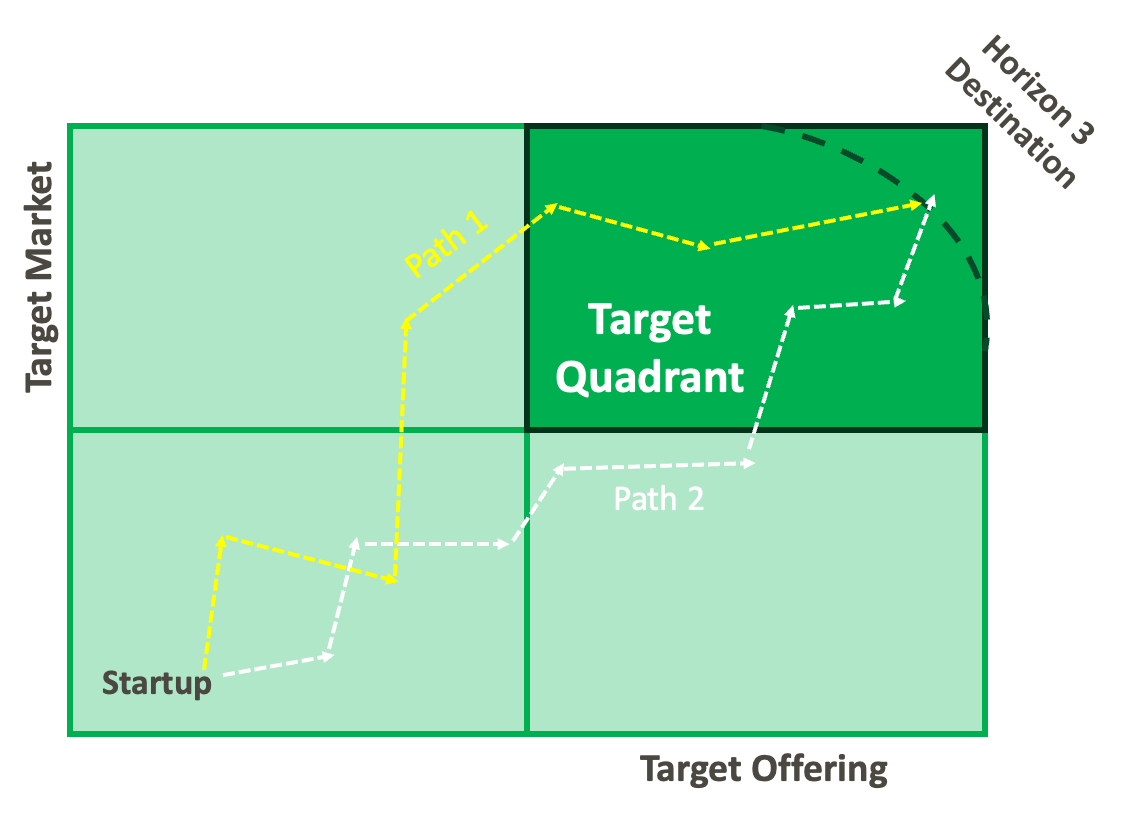
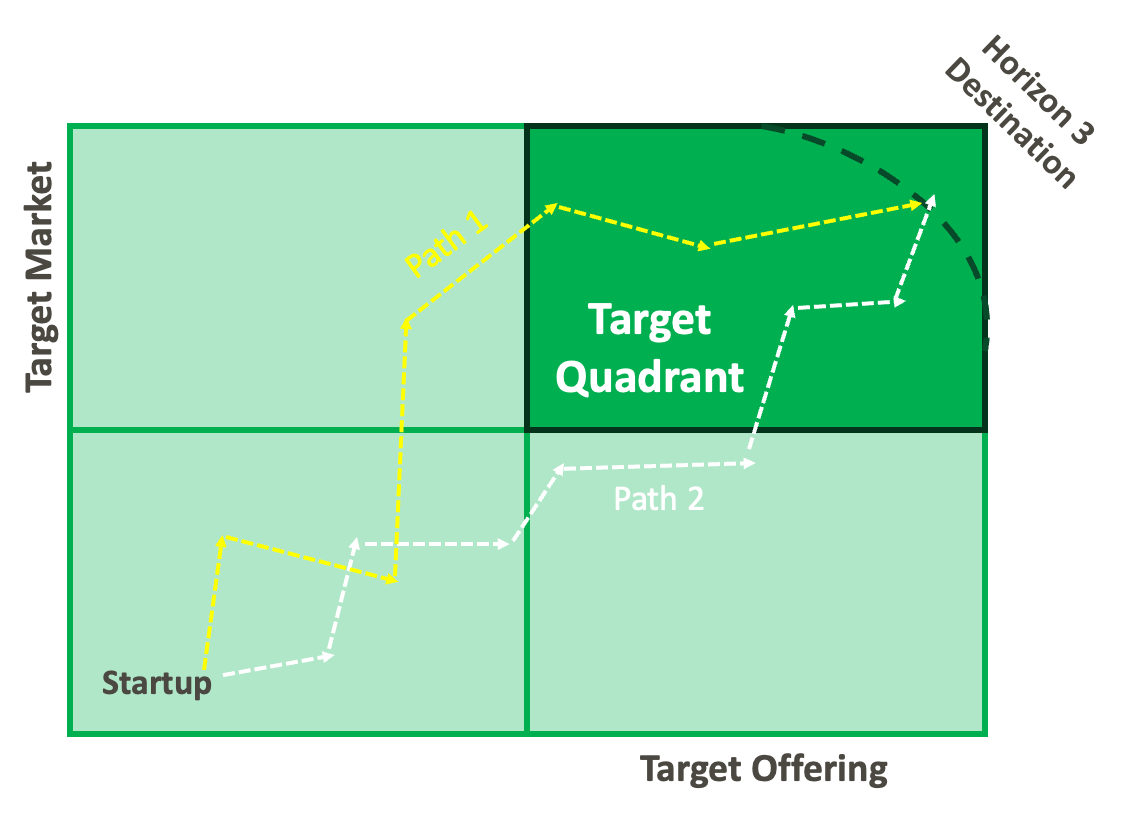
Lean startups and gradient descent are path dependent processes: multiple efficient paths may yield optimal outcomes in a discovery process with unknown unknowns. Figure 3 illustrates how local optimization may lead startups on two different efficient paths as they navigate toward their horizon three destination. Founders need only understand the desired quadrant for a startup destination to apply this method. The precise port may shift thirty degrees to the left or right as the startup approaches its destination.
Figure 3: Startup Iterative Optimization while Navigating through Fog toward its Destination
So far, we have considered only the direction of the next step when navigating through startup fog. Other factors deserve founder consideration as they optimize startup activity. In Thinking, Fast and Slow, Kahneman distinguishes between two modes of thought: fast, instinctive responses versus slower, deliberative decisions.
In system design, a core principle of resilient architectures is that short-term instability leads to long-term stability. Building tolerance for localized failures enables systems to adapt, automate recovery and withstand larger stresses. Rapid experimentation and adjustment creates short-term instability but accelerates improvements that help optimize for the long term.
Startups must move quickly and most decisions may be instinctive, but at least three classes of decisions require more careful consideration: (1) those involving significant commitments of time and resources; (2) highly visible decisions in which reputations are at stake; and (3) irretrievable decisions in which startups commit to a certain course of action. Jeff Bezos describes these as one-way doors rather than two-way doors.
As Robert Frost described in The Road Not Taken:
Two road diverged in a wood, and I – I took the one less traveled by, And that has made all the difference.
We return to the plane crash on an Alaskan glacier. The decision to stay with the plane or hike toward safety depends on proximity to safety, terrain, condition of the passengers, weather, provisions and equipment. Case studies indicate, however, that the decision to stay or go often reflects more on the predilections of decision makers than environmental factors.
Character matters in the fog of war. Startup culture reflects founder traits. Both persistence and adaptability are vital attributes for successful startups, and crucial decisions on whether to persevere or pivot depend both on personal predilections and business prospects.
The methods discussed here – first principle thinking, exploring widely to uncover hidden opportunities, hypothesis testing with carefully designed experiments, and gradient descent optimization to move iteratively toward a startup destination – are optimization strategies to prioritize business prospects over personal predilections while navigating through the fog of disruptive innovation.
Related Concepts
Startup pacing is essential to exploit windows of opportunity created by paradigm shifts. First movers advantage may be mitigated by fast followers that learn from early entrants and avoid technical debt. Lean startups remain agile prior to Product Market Fit but must scale quickly once the market settles on a dominant design.
Disruptive startups inhabit an uncertain world in which asymmetric information persists with stealth startups. The Five Forces model illuminates industry structure, though this may not be readily apparent in nascent or invisible markets. First Principals thinking may anticipate industry structure while superforecasting is an incremental, empirical approach to reevaluating opportunity in uncertain, volatile environments. The simplex algorithm is a linear programming alternative to gradient descent. A Serendipity Mindset expands the Luck Surface Area while a Day One Mentality cultivates a culture to exploit new opportunities.
- David Harper emphasized the role of anomaly detection in Entrepreneurship and the Market Process. Scott Shane asserted that prior knowledge dictates perception of opportunities whereby diverse knowledge helps identify opportunities that span multiple domains in Prior Knowledge and the Discovery of Entrepreneurial Opportunities. Israel Kirzner indicated that arbitrage is a primary means of identifying opportunities through pricing variance across domains in Perception, Opportunity and Profit. ↑