Company Culture: The Most Sustainable Source of Competitive Advantage

Paul Asel
Founding Partner at NGP Capital·
Company culture may create sustainable advantage or precipitate startup demise. Founders leave an indelible mark through the culture cultivated at the outset.
Idea in Brief
- Compelling company cultures are the most sustainable form of competitive advantage, more durable and less readily replicated than technology differentiation.
- Company culture predicates startup potential. A startup flawed at its foundation cannot be fixed.
- Employees transmit and personify company culture. High performers who reinforce company culture are the firm’s best asset.
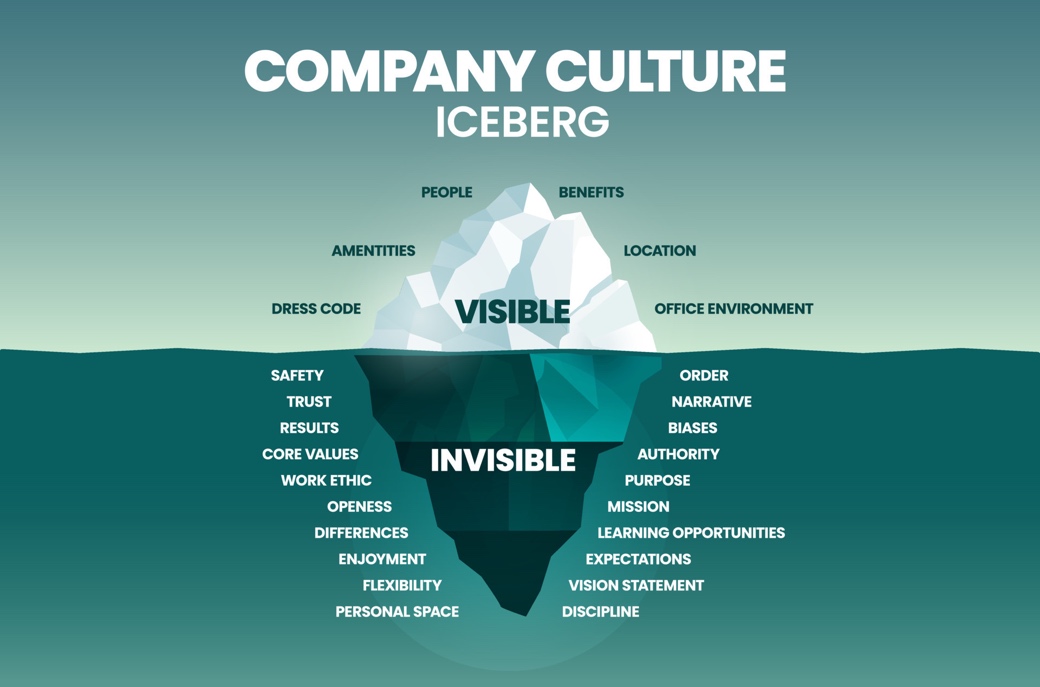
Companies culture is unvoiced yet often visible the moment one enters a corporate lobby. Amazon employees walk frenetically between meetings keeping pace with robots that roam their warehouse floors. Yelp sparkles with energy and buzz as employees bedecked in company t-shirts greet colleagues warmly and engage lively debates. An exuberance that energizes entries or a pensive pall that pervades premises often reveal more than CEO presentations.
Entrepreneurs and investors value technology differentiation and business model innovation, yet they too often ignore the most sustainable form of competitive advantage. Business model innovation can be readily replicated, and technology differentiation may erode quickly, but company culture is invisible to outsiders. Benchmarking may unearth industry best practices and new recruits bring technical know-how from prior experience, but culture remains non-transferrably distinct to organizations.
Stakeholders – investors, employees and partners – overlook company culture at their peril. Peter Thiel, founder of PayPal and managing partner at Founders Fund, observes that a startup flawed at its foundation cannot be fixed. Noam Wasserman noted in Founders Dilemmas that most companies die of self-inflicted wounds rather than external threats. Founders must navigate three internal thickets - relationships, roles and rewards – before serving customers and fending off competition.
Cultivating a compelling culture requires attentive care and vigilance. Company tenets codified in mission statements and policies mean little if not reinforced in daily practice. Firms ultimately ensnared in scandal are often the most vociferous proclaiming their company values. Enron’s 64-page Code of Ethics signed by Chairman and CEO Kenneth Lay in 2000 reads like fiction in light of the accounting scandals that enmeshed and ultimately bankrupted the business just a year later. Culture is manifest through leadership example and employee daily activity. It is most evident in how companies respond to crucible moments and employee conduct when no one else is looking.
Cultivating Company Culture
Mission driven businesses are a source of value through their ability to attract and retain talent. Stock options help align interests and create a shared sense of ownership. Mission driven businesses vest employee loyalty through a shared sense of purpose independent of pecuniary interests.
Company culture is best reinforced through recruitment and evaluation of talent. Companies that value culture recruit both for requisite skills and cultural fit. In his book How Google Works, former CEO Eric Schmidt said, “Never forget that hiring is the most important thing you do.” Google formalized the interview process ensuring that all offers for senior engineering and product positions required review at the executive level. Similarly, Goldman Sachs and McKinsey – leaders in investment banking and consulting, respectively – engage candidates at all business levels in a battery of interviews with later rounds focused primarily on cultural fit.
While many would agree that attracting talent is the top priority, founders must resist the temptation to shortcut the search process given the speed with which startups must move. Apple founder Steve Jobs is known for ingenious product design, yet he regarded "The secret to my success is that we have gone to exceptional lengths to hire the best people in the world."
Scott Sandell, Managing Partner of NEA, a leading venture firm, evaluates talent using a 2x2 matrix measuring both employee capacity and cultural fit. Employees who consistently meet or exceed performance targets while embodying company culture are leading candidates for promotion. High-performance cultures cannot tolerate employees who miss targets and do not aligned with company values.
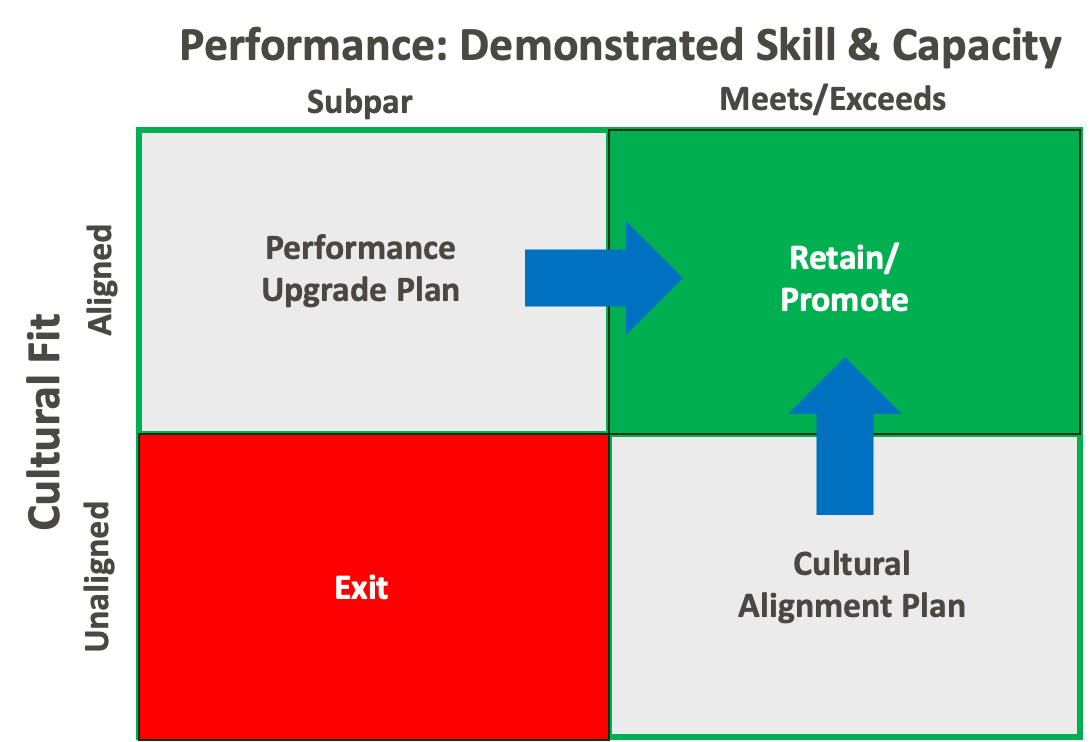
What happens when an employee is a star performer but erodes company culture? Or when an employee is a champion for company culture but misses performance targets? A performance-driven firm cannot tolerate subpar performance or cultural misalignment for long. Clear communication of missed expectations and course correction are required.
Employees who miss targets but have the capacity to perform well over time may be assigned to a new role that better matches skills and job requirements. Or the manager and employee may agree to an upgrade plan with training and mentoring to help bridge the performance gap.
Cultural misalignment is more challenging when star performers clash with firm values. The loss of a star performer and erosion of firm culture are both unappealing options. A star performer surely wants to succeed but will have options elsewhere and may resist behavior change if it impacts personal performance.
Yet the rewards for firms who navigate these cultural adjustments well can be highly rewarding both for the company and employee. In an Uncertain World, Robert Rubin acknowledged that he needed to change his behavior as a young employee at Goldman Sachs. Rubin adjusted so well that he was later nominated by his partners to co-lead the firm. He eventually served effectively as U.S. Secretary of the Treasury.
Cultivating a Compelling Company Culture from Inception
Culture emerges organically in startups but should not be left to chance. As Steve Jobs observed, founders impact on company culture is greatest at inception: "When you get a core group of ten great people, it becomes self-policing as to who they let into that group. So finding that core group and forging that is the most important thing I could do."
Founders should be as attentive to company culture at inception as they are to business strategy and product requirements. When contemplating a startup, consider the following questions:
- What best practices must you emulate to succeed?
- How could company cultural yield sustainable competitive advantage?
- How can your startup inculcate culture through policies, practices and talent?
- What tools and practices can you use to monitor and reinforce company culture over time?
A founder is wise to invest in company culture from the outset. A sense of mission and culture are the most indelible marks a founder may leave on a business. Strategy evolves with market conditions, and technology must be continually renewed else lapse into technical debt. Personnel are constantly in flux in a dynamic, growing firm. Yet a compelling mission and culture can be a company’s most sustainable asset over time.
Related Concepts:
Culture is one of the Founders Dilemmas that underlies relationships, roles and rewards within startups. Culture forms the atomic habits of a firm and helps align interests among the team. Be Exothermic and Assume Positive Intent are two examples of cultural values that have served startups well.
Venture investors consider technology differentiation as a primary source of sustainable competitive advantage, yet culture is harder to ascertain and replicate. Benchmarking calibrates industry best practice and helps firm develop a SWOT analysis to position the firm relative to competitors. Dominant Design is a product perspective on best practice.
The Who Scorecard helps firms assess performance capacity and cultural fit during the recruiting process. Cultural fit assesses personal alignment with firm values, while Founder Fit assesses alignment with market requirements.