
Lean Business Plans: Building Speed and Agility into Startup Preparation

Paul Asel
Founding Partner at NGP Capital·
Failing to plan is planning to fail, yet startups must remain nimble as markets evolve. Lean business plans establish a clear vision and strategy while permitting tactical flexibility to fulfill the mission.
Idea in Brief
- Startups thrive on speed and agility to offset traditional incumbent advantage.
- Fortune favors the prepared mind. Founders accelerate time to market by postulating responses to ten key questions prior to launching their startup.
- Lean Business Plans reinforce speed and agility through a sparse design and flexible planning approach.
Should you prepare a business plan before launching your startup?
Startups and the business plans that guide them inhabit unsettled territory. Startups thrive in rapidly changing, uncertain environments by nimbly outmaneuvering lumbering incumbents. Startup plans support founders by balancing the twin imperatives of agility and efficiency, especially as product development cycles have accelerated with the aid of artificial intelligence.
In the fog of war, plans are contested with the ferocity of fighting in no man’s land between opposing forces. As Dwight Eisenhower, commander of Allied forces in World War II observed, “plans are useless, but planning is indispensable.” When asked about an opponent’s plan for their impending fight, former world heavyweight champion Mike Tyson responded: “Everyone has a plan until they get punched in the mouth.”
This article helps founders weigh often conflicting advice on startup planning. Business schools promote business plans: MIT, for example, has taught Disciplined Entrepreneurship for nearly two decades using a 24-step process that takes would-be entrepreneurs three to six months to complete. Lean Canvas promotes a more agile approach in the Lean Startup tradition with a one-page template that may be completed in twenty minutes. The U.S. Small Business Association requires detailed business plans for debt financing, yet venture investors prefer presentations as the medium of choice.
Preferences for business plans or presentations may be form over function, yet they mask a larger debate regarding the optimal degree of planning amidst uncertainty. Startups wander rudderless in tempestuous seas when they navigate without a clear vision and strategy, yet startups must remain nimble in volatile market conditions. A good business plan, like a ship’s rudder, provides both ballast and flexibility to navigate turbulent waters well.
Startups with a plan are more likely to raise funding, grow up to 30% faster, and are 16% more likely to succeed than those who don't. Plans clarify a vision and strategy that help attract stakeholders, including investors, customers, partners and talent. Plans help align founders and investors reducing risk of later rifts. Preparation can save time, money and effort by deepening market knowledge, clarifying key assumptions, identifying potential fatal flaws, designing experiments to test key hypotheses testing, and anticipating competitor and customer responses.
Planning is a substantive process that aligns stakeholders, improves operating efficiency and accelerates time to market when done well. Planning enables founders to consider a range of potential business opportunities, product designs and business models before committing time, talent and treasure to a new venture. As Abraham Lincoln quipped, “Give me six hours to chop down a tree and I will spend the first four sharpening the axe.” The business equivalent is measure twice, cut once. As investors use filters to quickly sort through potential investments, founders may consider these ten questions when evaluating startup options:
- Insight: Is the idea distinctive and compelling? Is the problem widely recognized?
- Market Opportunity: Is the market large enough?
- Founder Fit: Is this the right team to win the market?
- Timing: Is the timing right? Why now and not earlier? Will it remain relevant for the next decade?
- Product: Is the product highly differentiated? Is it a novel, breakthrough technology?
- Competitive Advantage: Can the startup achieve market leadership given the market structure and dynamics?
- Business Model: Who are the target customers, channels, partners? What are their adoption requirements? How does this inform go to market and pricing strategy?
- Financial: Do the unit economics support a highly profitable business at scale? What are the key metrics and break-even level?
- Funding: Is the business capital intensive? How much funding is required now and over time? What are the expected returns at scale?
- Challenges: What could go wrong? Can the team adapt as needed? Buffer time and capital available?
Yet business planning involves potential pitfalls. Business plans can ossify a business much as technical debt encumbers product development. Plans can lead to analysis paralysis in uncertain markets and become outdated in rapidly changing environments. Business plans may lock in founders retarding responses to changing market conditions. Financial projections provide a patina of predictability yet may mislead by embedding lofty assumptions and inviting conjecture beyond a very short timeframe. Overengineered business plans expand into bloatware: among over 550 sample business plans assembled by Liveplan, the average plan exceeds 20 pages, including a 45-pager for a technology startup entering a nascent market.
Business planning should adjust to the nature of the market. Operating in stealth mode in new, uncharted markets allows ample time to develop and test the concept, while a sense of urgency is required in visible, highly competitive markets. Established, stable industries permit more robust business plans than in nascent, unproven markets involving unknown unknowns discoverable only once in market. Lean, agile plans can be readily updated in uncertain, rapidly changing markets, yet a more intimate knowledge of customers is essential for startups considering complex products with extensive development requirements and long sales cycles. Investors in capital intensive industries require more detailed plans than startups that can be bootstrapped initially. Table 1 indicates how varying market and startup conditions alter optimal planning requirements.
Table 1: Selected Market and Startup Considerations that Alter Optimal Planning Requirements

Lean startups are agile by design, and lean business plans reinforce agility. The Lean Canvas template shown in Table 2 covers the basic factors you should consider in startup planning regardless of your business plan length and format. You may consider a one-page summary for easy reference with your team, a ten-slide presentation to share with investors, and a more detailed written plan that enables you to carefully consider the nuances of product design, target market, business model alternatives and sales strategy before committing to the business. Amazon, for example, uses a six-page written summary to evaluate any new initiative of consequence.
Table 2: Lean Startup – Standard Business Planning Topics
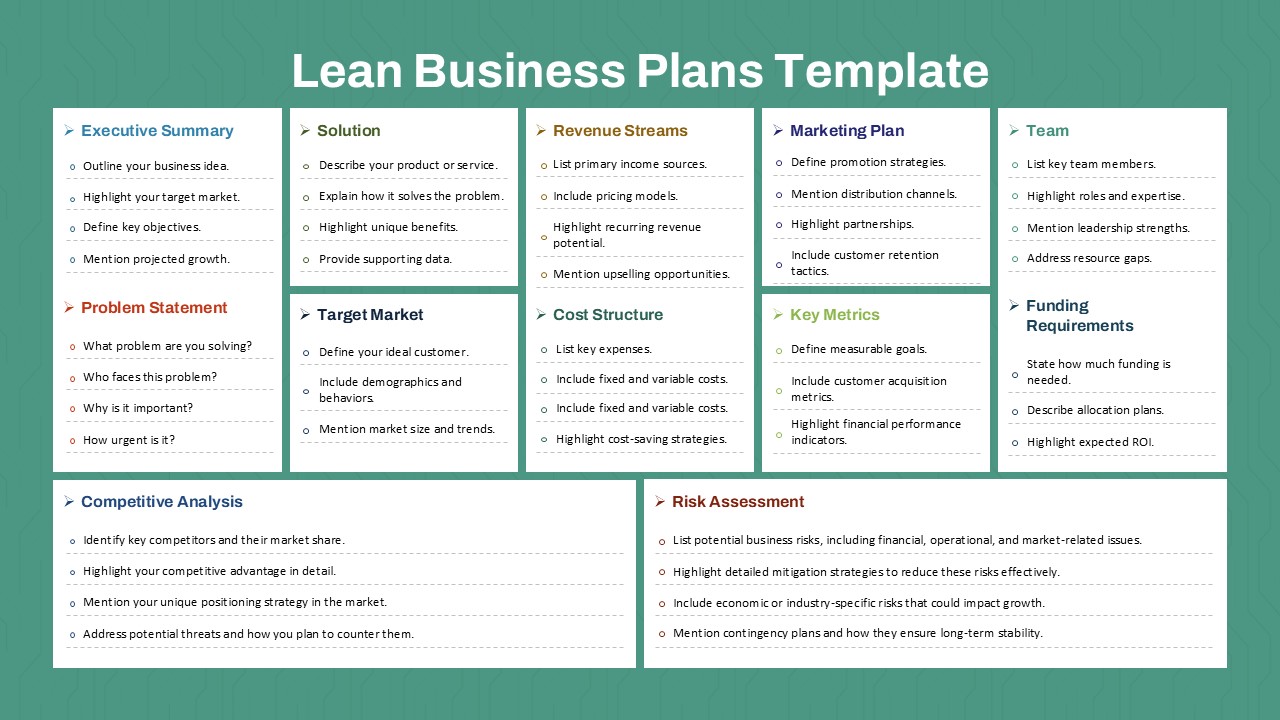
The elements of a startup plan are consistent across industries and business stages, though the level of detail will increase as industries and businesses mature. The executive summary identifies the key insight and market potential. The problem statement addresses market timing while the solution discusses product differentiation. The team section may address Founder Fit. The marketing and financial plans should explain the business model. The competitive analysis should explain company positioning and how the startup can win the market. The risk assessment addresses how the company will respond to and mitigate potential challenges.
A lean startup plan reinforces agility both through its sparse design and flexible planning approach. A bullet point format permits rapid adjustments in response to customer feedback, technology advances or market change. Tracking startup evolution through various versions of the business plan celebrates change, reinforces agility, and illustrates company and market progress over time.
The lean startup plan differs from traditional business plans in function as well as form. Lean startup business plans reinforce a flexible planning approach. The proposed product or service anticipates adjustments based on market feedback. Market structure is ascertainable but market and competitive dynamics could change dramatically. The financial section focuses on key revenue and cost drivers to ascertain unit economics, revenue and profit potential at scale rather than offering detailed five-year financial projections common in traditional business plans. The team section acknowledges resource gaps to fill as the firm grows.
Uncertainty is oxygen for startups. Startups thrive on speed and agility to offset scale advantages of incumbents. Business planning should accelerate speed and agility by anticipating change and preparing to adapt as needed. Lean business plans reinforce a prepared mind and are the rudders that provide both the ballast and nimbleness enabling founders to navigate well and seize opportunity in turbulent waters.
Related Concepts:
Business plans are a Forcing Function to define the startup insight and rigorously consider opportunities and threats. Lean business models leverage the Business Model Canvas design and an iterative approach practiced in Superforecasting to reinforce lean startup agility. Fortune Favors the Prepared Mind, and lean business plans may accelerate the Innovation Flywheel and seize the Window of Opportunity by enabling founders to better assess the Market Opportunity, anticipate Market Structure and respond more effectively to challenges as they arise. Business plans assist fundraising efforts by enabling startups to affirmatively respond to Investment Filters used by investors.